NAWM Webinars/Conference Schedule
The National Association of Wetland Managers (NAWM) offers a Hot Topics Webinar Series that focuses on timely issues and studies such as new and emerging wetland policy and law, innovative tools and technology and state-of-the-art practices. These webinars are advertised through our website, newsletters, social media and emails.
For more information and/or to join our email list for notices about upcoming events, please contact Laura Burchill at laura@nawm.org or (207) 892-3399.
View a List of Past Hot Topics Webinar Recordings Here
Please click on a year below to view past webinars.
 Training Series Goals
This webinar series has been designed to provide participants with a general level of knowledge about wetlands and wetland restoration options and considerations. Participants will come away from trainings with key knowledge, the ability to be more conversant about wetland issues, knowing what questions to ask when looking at restoration opportunities, and knowing when to contact or bring in an expert. This webinar series ties in with the Natural Resource Conservation Service’s (NRCS) nine-step planning process, focusing on Phase I collection and analysis steps: identify problems, determine objectives, inventory resources and analyze resource data.
For more information and/or to join our email list for notices about upcoming events, please contact Laura Burchill at laura@nawm.org or (207) 892-3399.
View a List of Past NRCS Conservation Planners Training Webinar Recordings Here
Target Audience
This webinar series has been developed to train Level 1and 2 NRCS Conservation Planners in field offices about key wetland concepts and restoration considerations as they work with clients on issues that involve wetlands. Additional targeted audiences include state and tribal wetland program staff, district staff, others working with NRCS Planners, staff from other agencies working on these issues (e.g. Forest Service, Bureau of Land Management), and NRCS non-planners who would benefit from this knowledge/skill-building. Participants to not require prior knowledge of or training on wetlands.
As a result of participating in this training series, participants will:
- Know how to read the landscape
- Know how to recognize and capitalize on opportunities with landowners, both when the landowner wants their land altered or they want to restore it
- Have an awareness of which tools are available and for what applications
- Understand programmatic options (e.g. Environmental Quality Incentives Program (EQIP), Conservation Reserve Program (CRP), Partner Programs)
How to View the Webinars
This webinar series consists of nine individual webinars. While each webinar has been designed to be able to function as a stand-alone training resource, participants will get the most benefit from the webinars by watching them in sequential order, as each webinar builds off the prior webinars in terms of building a foundation of knowledge.
Webinars in the Training Series
Webinar 1: Introduction to Wetlands - June 22, 2018
Webinar 2: Wetlands in a Watershed/at the Landscape Scale - August 15, 2018
Webinar 3: Wetland Ecology for Planners: How a Wetland Should Function - November 14, 2018
Webinar 4: Wetland Ecology for Planners: Examples of Variation Across the United States - December 14, 2018
Webinar 5: Dealing with Reality: How to Work with Wetlands in Altered Landscapes - February 15, 2019
Webinar 6: Identifying Resource Concerns and Determining Landowner Objectives - Presentations Recorded December 2019 (Non-Live Webinar)
Webinar 7: How to Talk about Wetlands with Landowners - Presentations Recorded December 2019 (Non-Live Webinar)
Webinar 8: What are the Choices and Benefits? Matching Objectives to Programs and Getting Additional Help - August 5, 2019
Webinar 9: Dealing with Challenging Weather Patterns in Wetland Restoration Planning - May 6, 2019
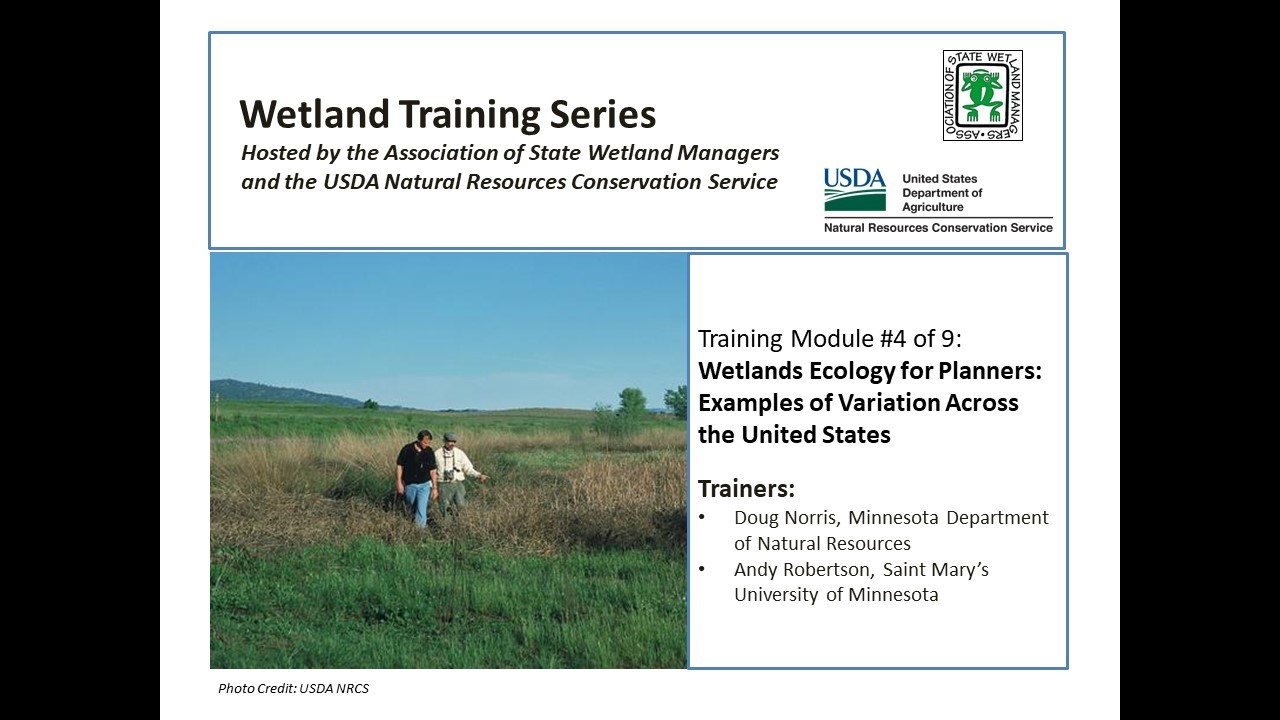
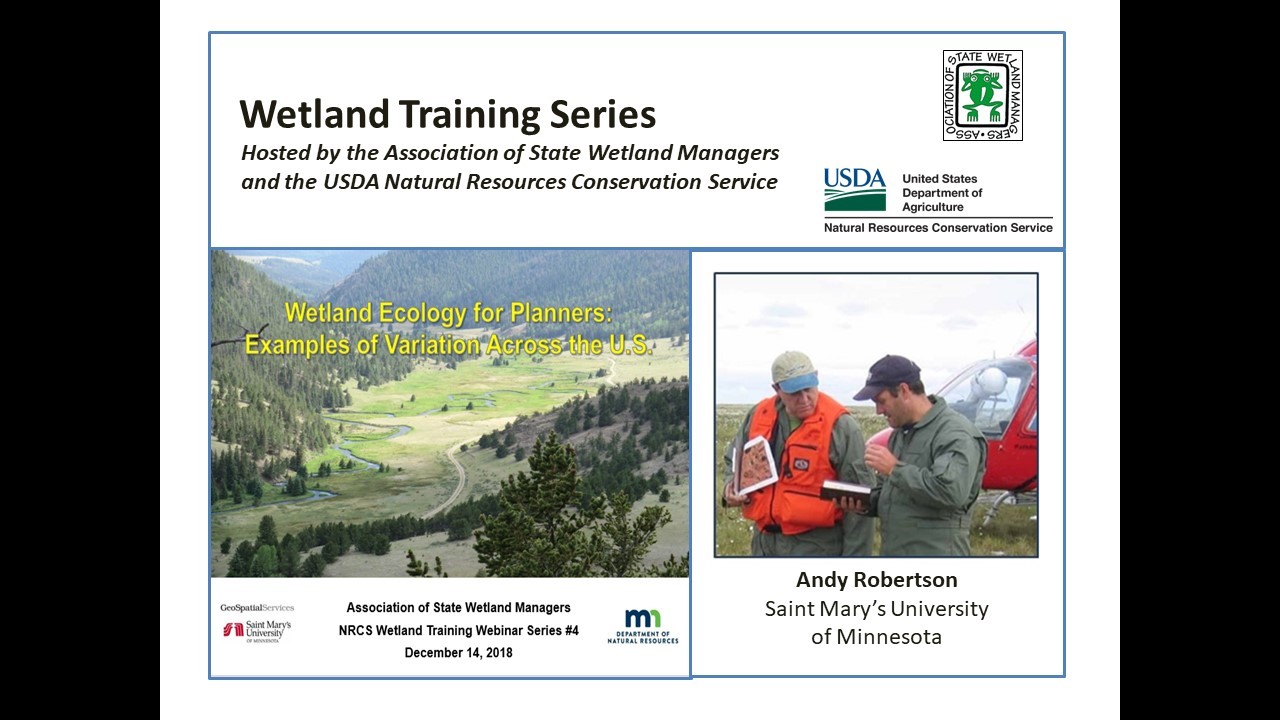
 Webinar 4: Wetlands Ecology for Planners - Examples of Variation Across the United States
Held Friday, December 14, 2018 at 3:00-5:00 pm ET

INTRODUCTION
Jeanne Christie, National Association of Wetland Managers [POWERPOINT PRESENTATION]
PRESENTERS
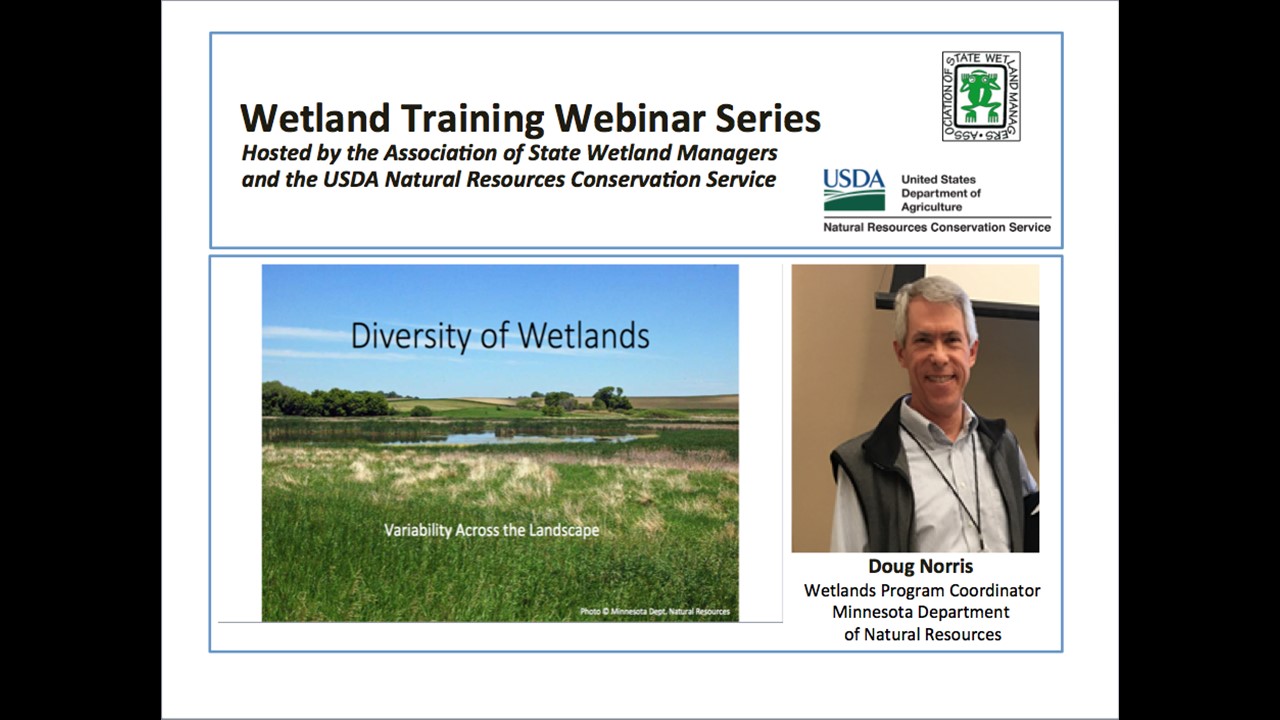
- Doug Norris, Wetland Program Coordinator, Minnesota Department of Natural Resources [POWERPOINT PRESENTATION]
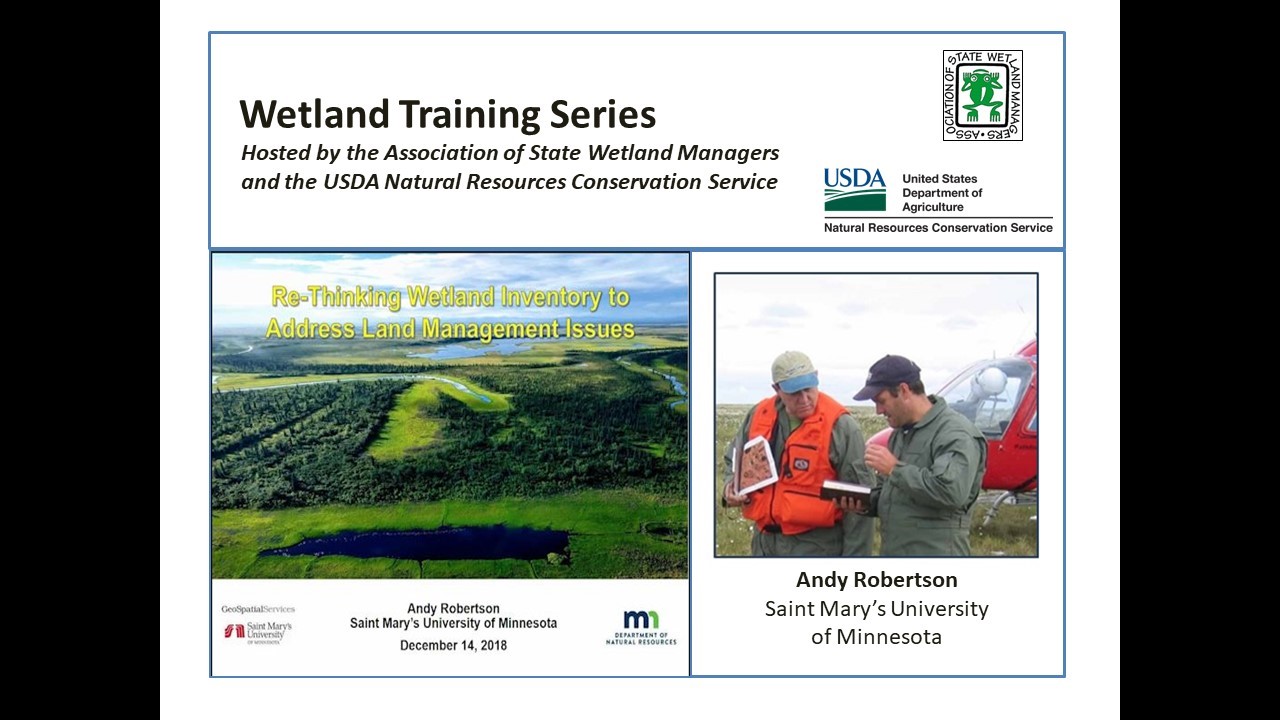
- Andy Robertson, Executive Director, Geospatial Services, Saint Mary’s University of Minnesota [POWERPOINT PRESENTATION]
ABSTRACT
This is the fourth webinar in NAWM and NRCS’s jointly-developed nine-part wetland training webinar series. The webinar began with a presentation on the variability in wetlands across the country, including how specific wetland functions and services vary by wetland type. The webinar reviewed these functions and services, which include wildlife habitat, flood attenuation, water quality improvement, recreational opportunities and more. The webinar then move to a second presentation on wetland benefits and their impact on other resources at the watershed scale. This topic was explored through three cases examining how climatic fluctuation, flooding and water quality are impacted by the presence and/or absence of wetlands (wetland loss/wetland restoration). Participants will come away from the webinar with an increased understanding of variability of wetlands and their associated functions and services nationwide, as well as how wetland loss and wetland restoration can have impacts at the watershed scale.
BIOS
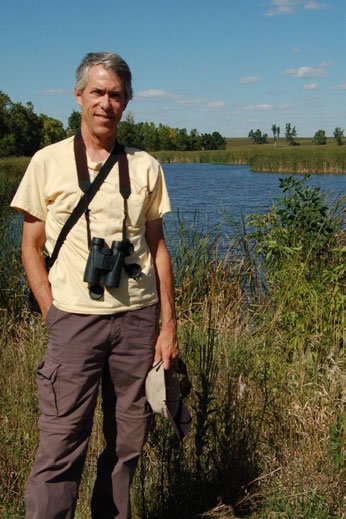 Doug Norris is the Wetlands Program Coordinator for the Minnesota Department of Natural Resources in St. Paul, Minnesota. His responsibilities include wetland policy development, providing technical assistance on wetlands, developing wetlands-related data such as updated National Wetland Inventory maps and wetland status and trend data, and administering the DNR’s regulatory responsibilities for calcareous fens. Doug held previous positions with the St. Paul District, Corps of Engineers and for the U.S. Fish and Wildlife Service in Bloomington, Indiana. He graduated from Purdue University (B.S. -Wildlife) and from the University of Missouri (M.S. - Fisheries and Wildlife).
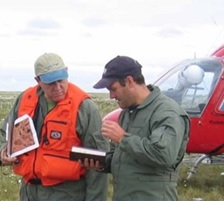 Andy Robertson is currently Executive Director of GeoSpatial Services at Saint Mary’s University of Minnesota. In this role, Andy is responsible for oversight and management of all GeoSpatial Services projects, activities and staff. GeoSpatial Services is engaged in a wide variety of projects across the Lower 48 and Alaska including: wetland inventory; National Hydrography Dataset updates; spatial data development; and, natural resource condition assessments. Andy earned a Forest Technology Diploma from Sault College of Applied Technology in Ontario, Canada, a B.Sc. in Environmental Science from the University of Waterloo and completed postgraduate work in forest management at the University of Toronto. GeoSpatial Services has been a key partner of the USFWS and has been working for over 15 years to update legacy National Wetland Inventory data across the nation. Andy is a steering committee member for the NAWM Wetland Mapping Consortium and is co-chair of the Alaska GeoSpatial Council Wetland Technical Working Group.

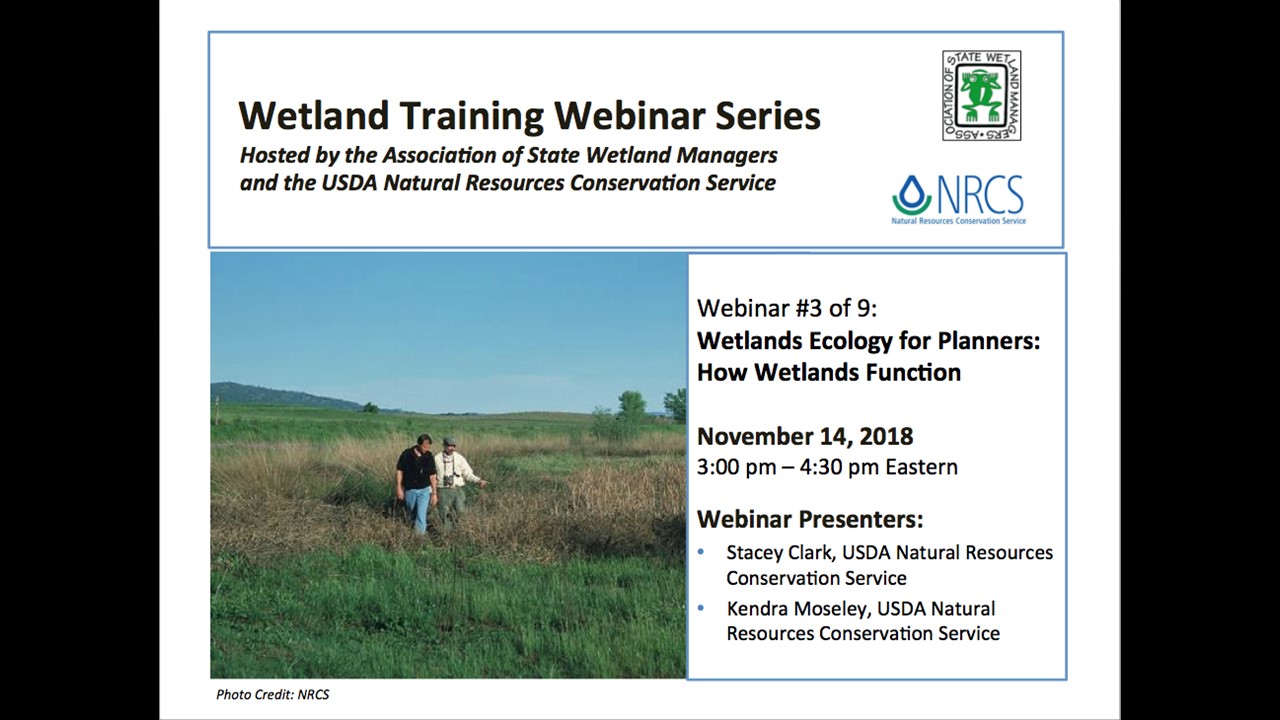
Webinar 3: Wetlands Ecology for Planners - How Wetlands Function
Held Wednesday, November 14, 2018 at 3:00-4:30 pm ET
INTRODUCTION
- Brenda Zollitsch, Policy Analyst, National Association of Wetland Managers [POWERPOINT PRESENTATION]
- Stacey Clark, USDA Natural Resources Conservation Service [POWERPOINT PRESENTATIONS]
PRESENTERS
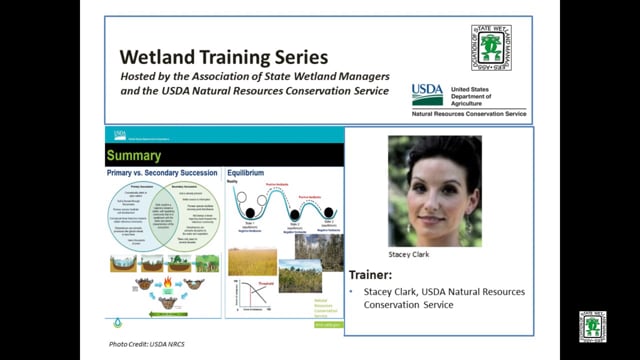
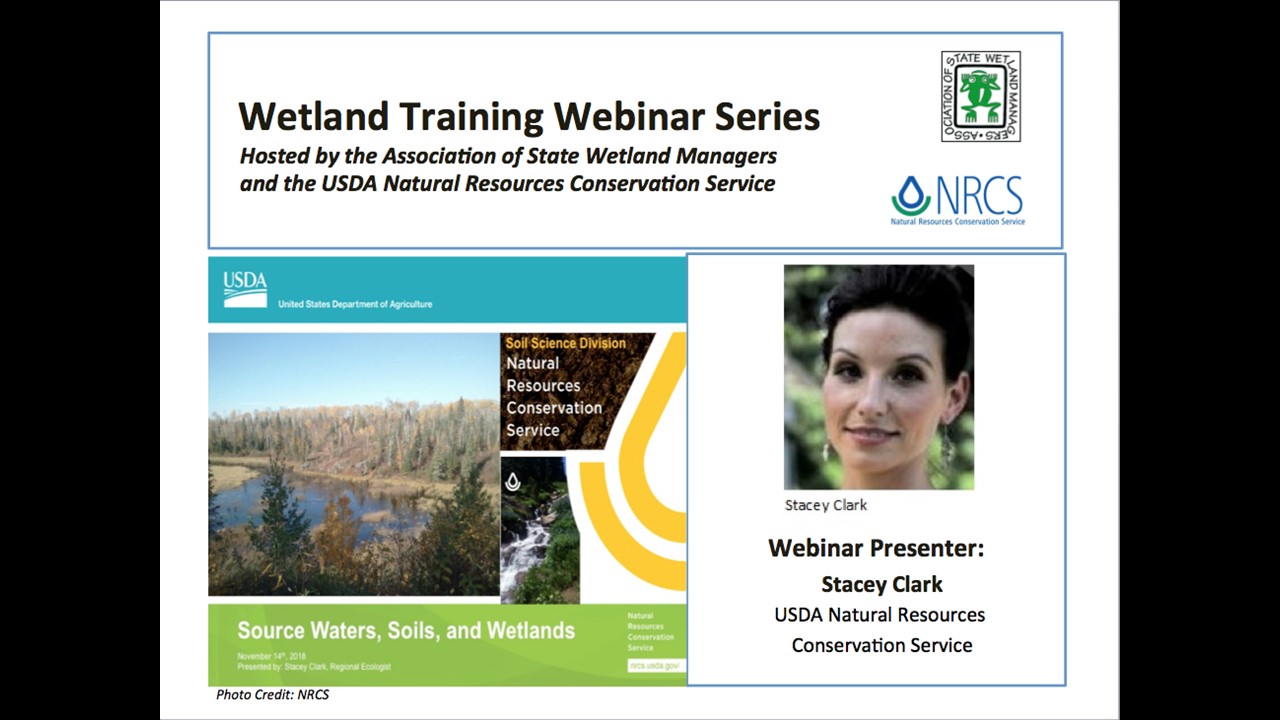
- Stacey Clark, USDA Natural Resources Conservation Service [POWERPOINT PRESENTATION] SUMMARY [POWERPOINT PRESENTATION]
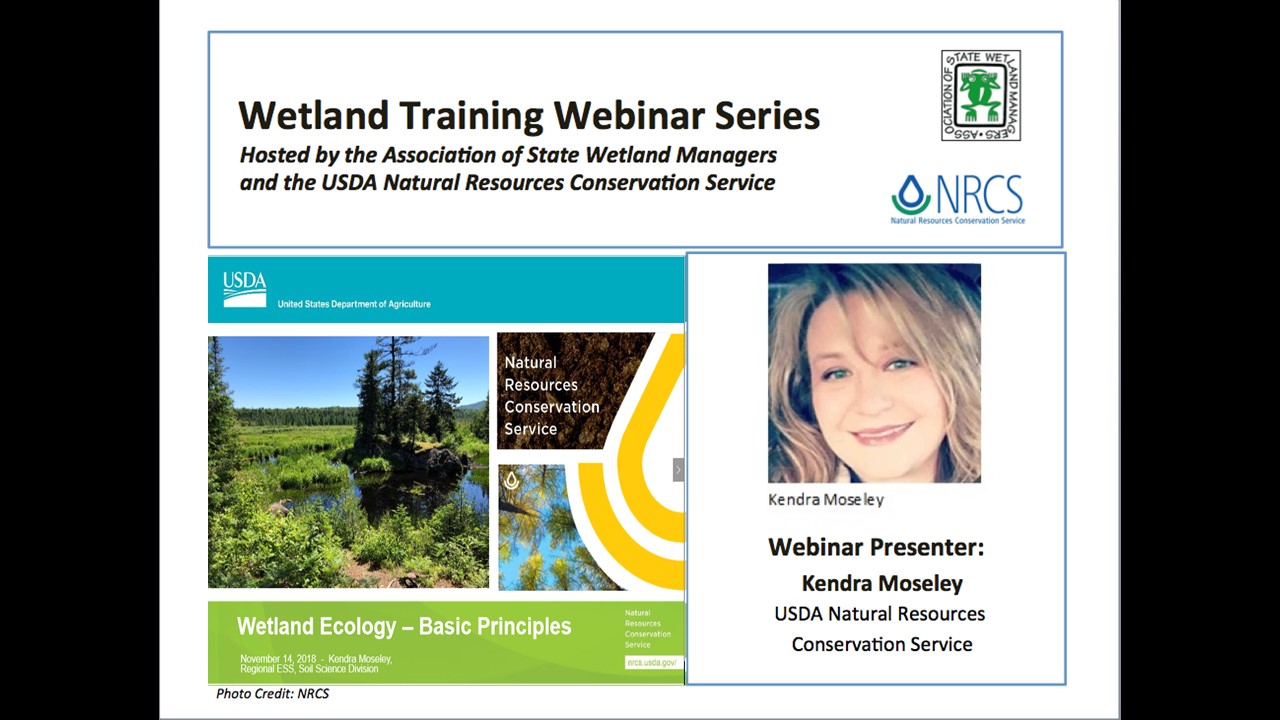
- Kendra Moseley, USDA Natural Resources Conservation Service [POWERPOINT PRESENTATION]
ABSTRACT
This is the third webinar in NAWM and NRCS’s jointly-developed nine-part wetland training webinar series. The first half of the webinar focused on explaining general wetland ecology concepts, including succession, thresholds, disturbance, sensitivity and resilience. The second half of the webinar identified how source waters (surface and groundwater) and soils define the character of a wetland, including an introduction to the Hydrogeomorphic Wetland Classification System (HGM). Participants will come away from the webinar with an increased understanding of how to consider these key concepts as they plan conservation and management activities that include wetlands.
BIOS
 Stacey Clark is a USDA Natural Resources Conservation Service Ecologist. Stacey has been an ecologist for NRCS since 2011. From 2008-2011, she served as a plant ecologist for the Minnesota Department of Natural Resources. Prior to this, she worked as a Forestry Technician with the U.S. Forest Service. Stacey holds a Master’s degree in Forest Ecology from the University of Minnesota – Twin Cities and a Bachelor of Science in Animal Sciences and Zoology from Michigan State University.
 Kendra Moseley is a USDA Natural Resources Conservation Service Quality Assurance Specialist focused on the development of ecological site concepts and ecological site descriptions. Her area of responsibility is from Alaska, the Pacific NW, California, Nevada, and down to Hawaii and the Pacific Islands Area. She works to ensure that all ecological site work being conducted in relation to the NRCS, including all agency projects, interagency MOUs, contract agreements, and research projects meet the existing NRCS National standards, policies, and guidelines. Kendra has been involved in the development of many of the national standards and guidelines that currently exist related to the development of ecological site concepts and site descriptions. Kendra holds both her Master of Science in Restoration Ecology and her Bachelor of Science in Rangeland Ecology and Management from the University of Idaho.
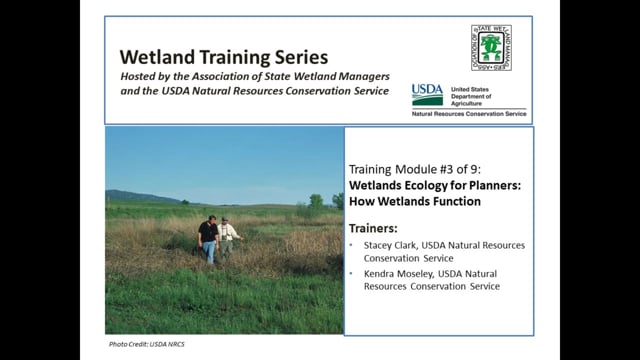

Part 3.0: Welcome: Brenda Zollitsch, Policy Analyst, Association of State Wetland Managers
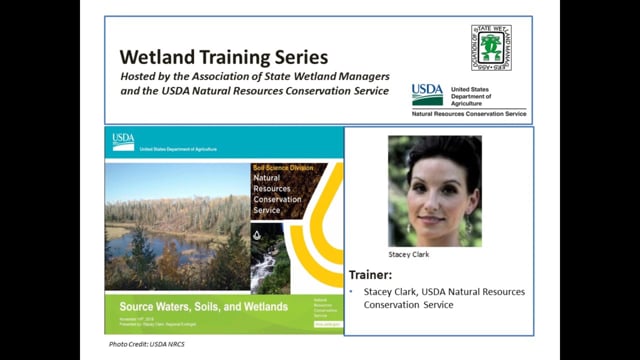
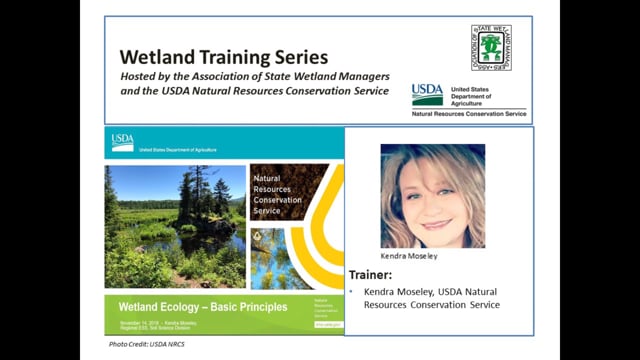
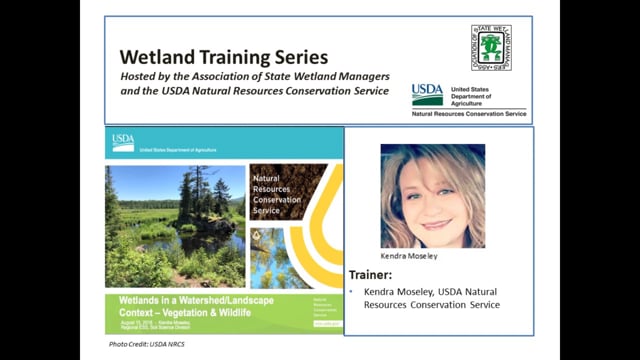




Webinar 2: Wetlands in a Watershed at the Landscape Scale
Held Wednesday, August 15, 2018 at 3pm ET
INTRODUCTION
- Brenda Zollitsch, Policy Analyst, National Association of Wetland Managers
[POWERPOINT PRESENTATION] - Kendra Moseley, USDA Natural Resources Conservation Service [POWEROINT PRESENTATION]
PRESENTERS
- Kendra Moseley, USDA Natural Resources Conservation Service
- Wetlands in a Watershed/Landscape Context - Vegetation & Wildlife [POWERPOINT PRESENTATION]
- Summary [POWERPOINT PRESENTATION]
- Lenore Vasilas, USDA Natural Resources Conservation Service [POWERPOINT PRESENTATION]
- Stacey Clark, USDA Natural Resources Conservation Service
- Wetland Functions and Land Use [POWERPOINT PRESENTATION]
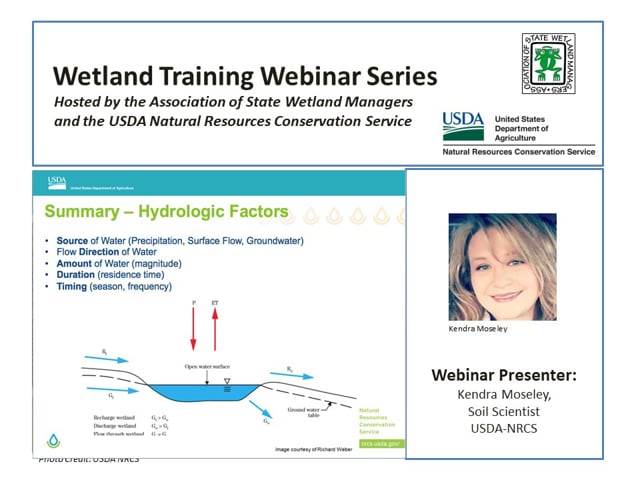
- Wetland Hydrology [POWERPOINT PRESENTATION]
ABSTRACT
This second webinar in NAWM and NRCS’s jointly-developed nine-part wetland training webinar series began with an overview of where wetlands can occur in landscapes. Next, the webinar explored the three key considerations with wetlands – hydrology, geology (soils), and vegetation. The presenters covered the importance of hydrology for wetlands, including temporal changes and the importance of time scale, the soil-water relationship and parent/source materials when looking at hydric soils, as well as kinds of wetland plants and what plant patterns tell you about how water runs off the land and the wetland itself. This webinar also covered influences from specific living resources, how different land uses affect wetlands (with a focus on agricultural land use), and how wetlands are a reflection of their surrounding landscape and watershed. The webinar concluded with discussion on how wetlands change over time and tools that can be used to understand these changes. Participants will come away from the webinar with an increased understanding of patterns on the landscape, how to identify wetlands at the watershed and field level and prepare to look at individual wetland sites.
BIOS
Kendra Moseley is a USDA Natural Resources Conservation Service Quality Assurance Specialist focused on the development of ecological site concepts and ecological site descriptions. Her area of responsibility is from Alaska, the Pacific NW, California, Nevada, and down to Hawaii and the Pacific Islands Area. She works to ensure that all ecological site work being conducted in relation to the NRCS, including all agency projects, interagency MOUs, contract agreements, and research projects meet the existing NRCS National standards, policies, and guidelines. Kendra has been involved in the development of many of the national standards and guidelines that currently exist related to the development of ecological site concepts and site descriptions. Kendra holds both her Master of Science in Restoration Ecology and her Bachelor of Science in Rangeland Ecology and Management from the University of Idaho.
 Lenore Vasilas is a USDA Natural Resources Conservation Service Soil Scientist on the Soil Science Division Technical Soil Services Staff. She has been a soil scientist for NRCS for 28 years working for the first 7 years on soil survey and the rest of her career in various positions, concentrating on hydric soils issues. She has been a member of the National Technical Committee for Hydric Soils for 20 years and is the current chair of the committee.
Stacey Clark is a USDA Natural Resources Conservation Service Ecologist. Stacey has been an ecologist for NRCS since 2011. From 2008-2011, she served as a plant ecologist for the Minnesota Department of Natural Resources. Prior to this, she worked as a Forestry Technician with the U.S. Forest Service. Stacey holds a Master’s Degree in Forest Ecology from the University of Minnesota – Twin Cities and a Bachelor of Science in Animal Sciences and Zoology from Michigan State University.
Part 2.0: Welcome and Overview: Brenda Zollitsch, Policy Analyst, Association of State Wetland Managers

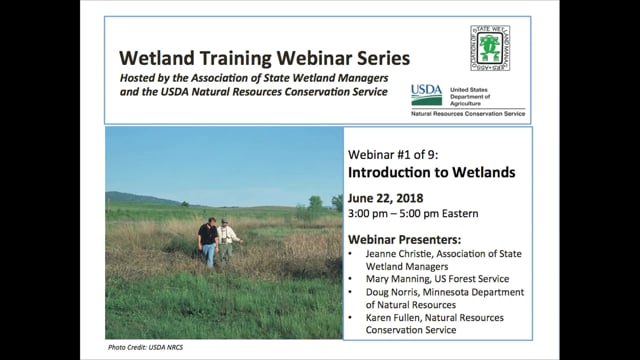
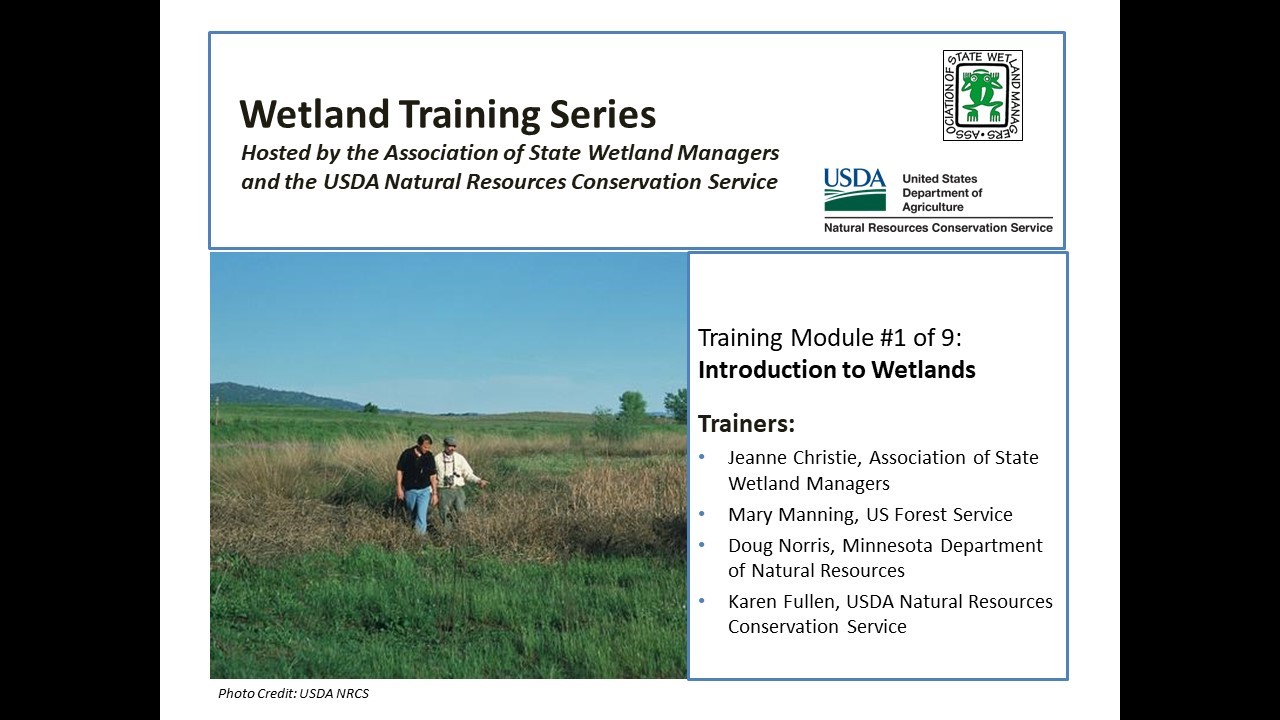
Webinar 1: Introduction to Wetlands
Held Friday, June 22, 2018 at 3pm ET
INTRODUCTION
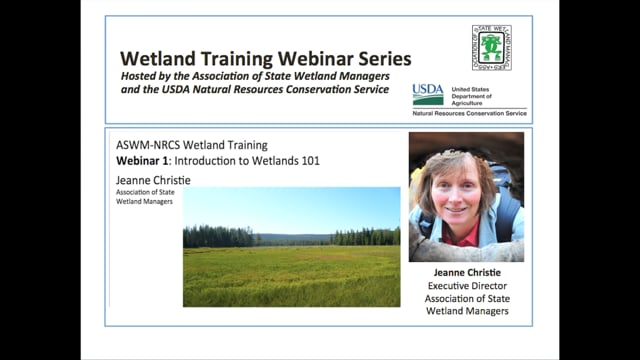
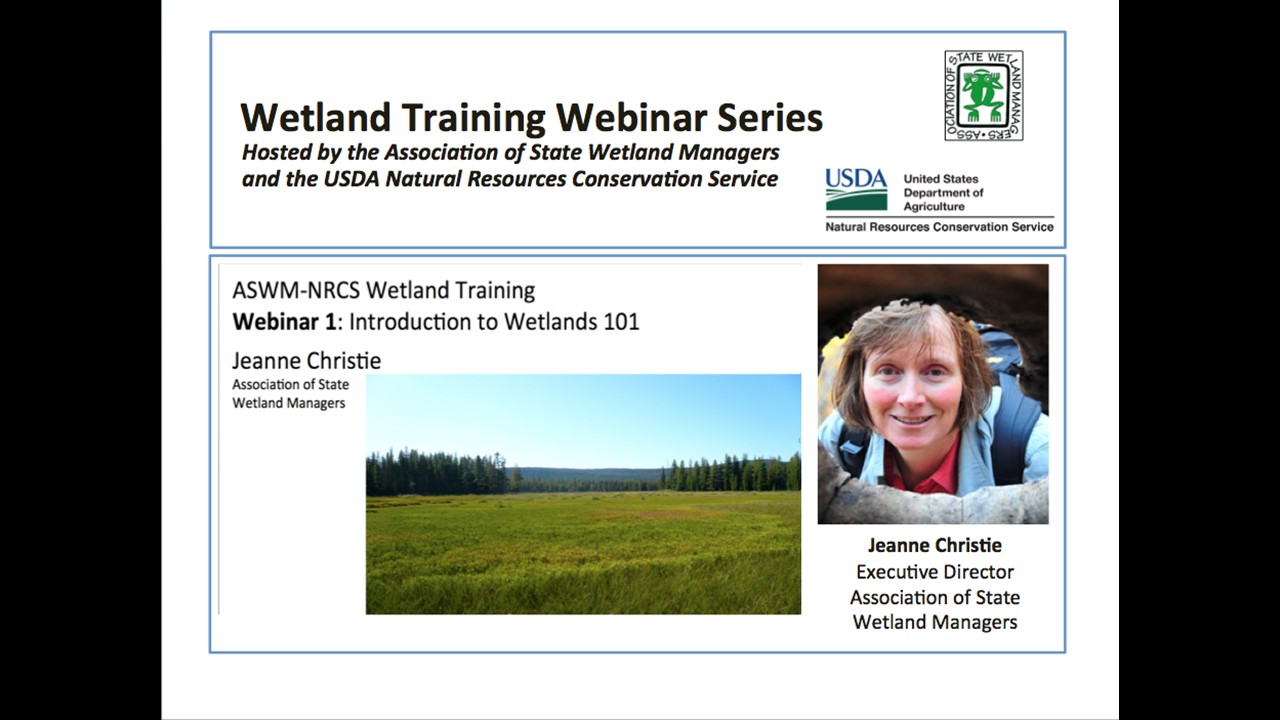
- Jeanne Christie, Executive Director, Association of State Wetland Mangers
- Brenda Zollitsch, Policy Analyst, National Association of Wetland Managers
[POWERPOINT PRESENTATION]
PRESENTERS
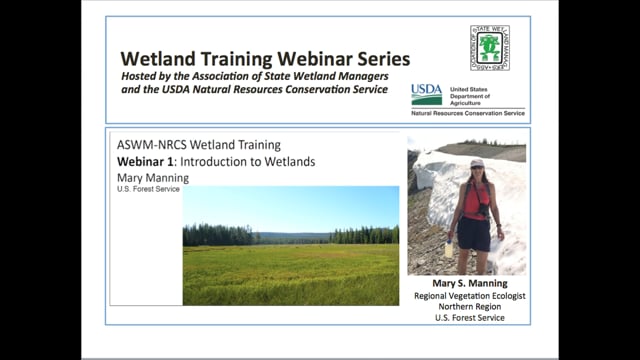
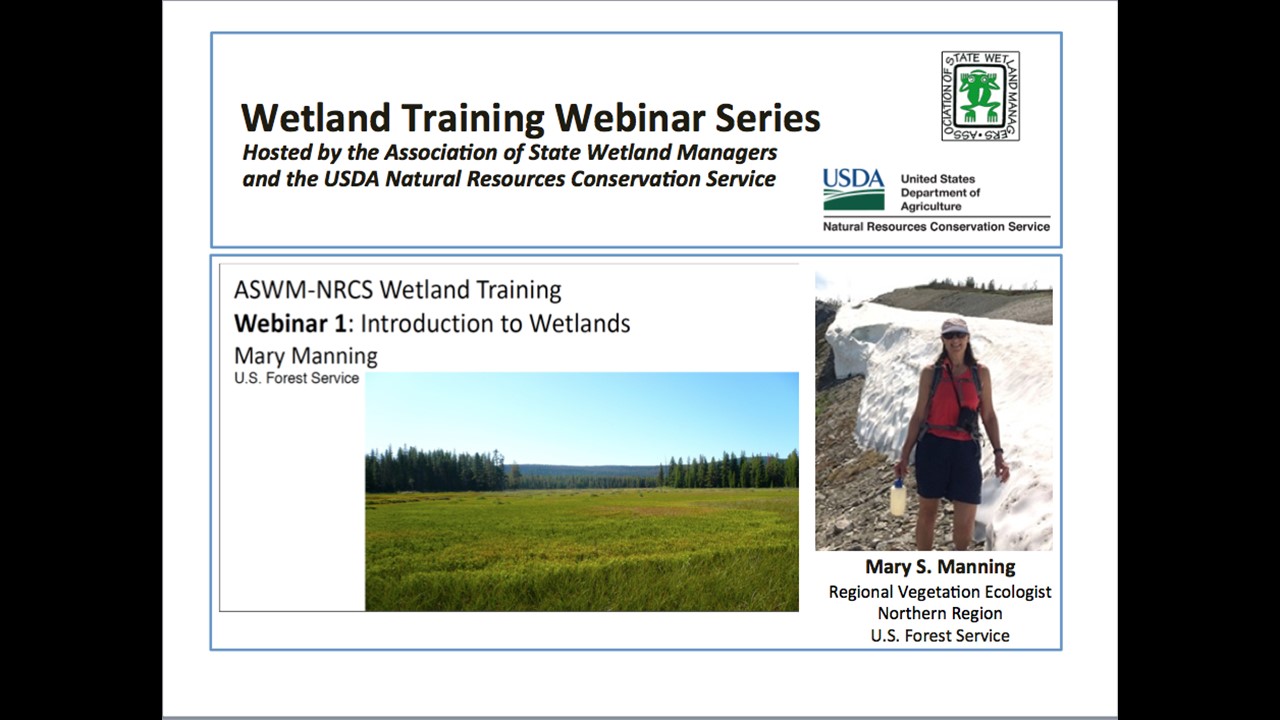
- Mary Manning, US Forest Service [POWERPOINT PRESENTATION]
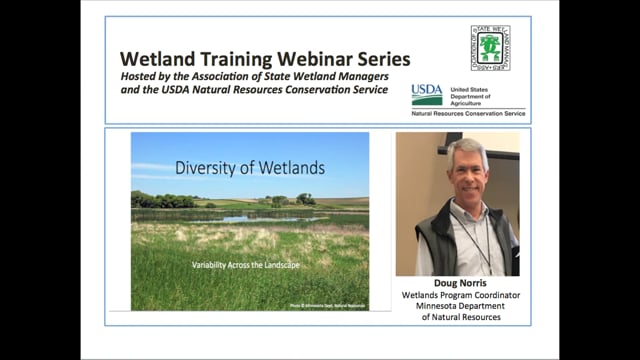
- Doug Norris, Minnesota Department of Natural Resources [POWEROINT PRESENTATION]
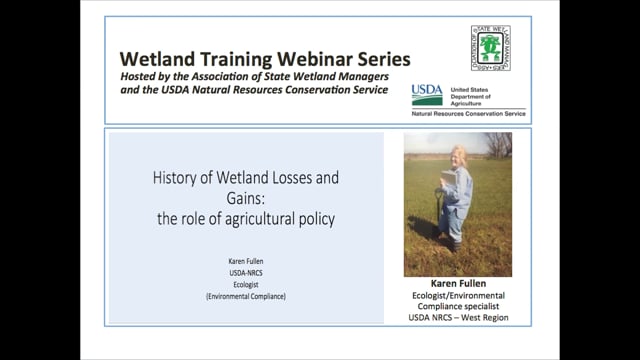
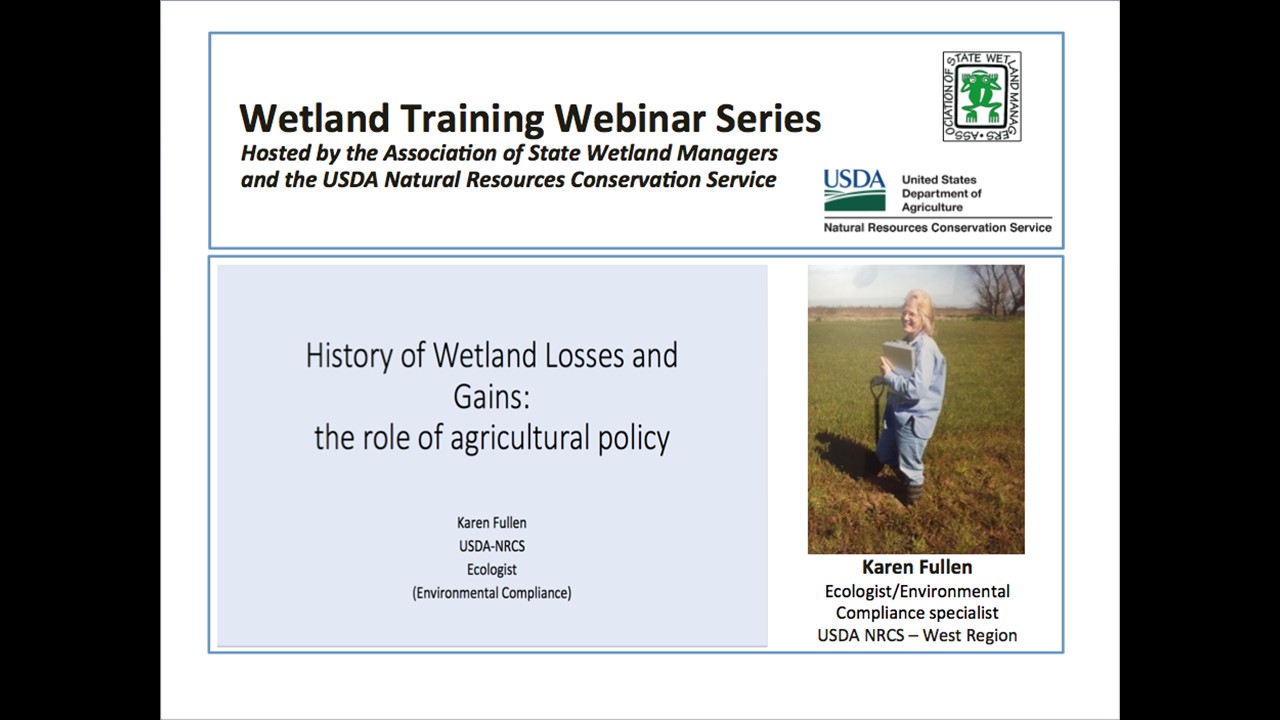
- Karen Fullen, USDA Natural Resources Conservation Service [POWERPOINT PRESENTATION]
WEBINAR DISCUSSION
This first webinar in NAWM and NRCS’s jointly developed nine-part wetland training webinar series provided an introduction to wetlands. The webinar started with introducing the primary components of a wetland, moving on to what makes wetlands distinctive from other types of waters and land. Next, the webinar covered the variability of wetlands across the landscape, including across seasons and time and the benefits of wetlands. The training concluded with a discussion of the history of and changes in agriculture policy in relation to wetland losses and gains. By the end of the webinar, participants will be able to describe what a wetland is and be able to explain to others the value of wetlands.
BIOS
 Mary Manning is the Regional Vegetation Ecologist for the Northern Region of the US Forest Service, in Missoula, MT. She focuses on vegetation classification, assessment, inventory and monitoring, primarily in shrubland, grassland and riparian/wetland vegetation. She also works on climate change related assessments and forest plan revision.
Doug Norris is the Wetlands Program Coordinator for the Minnesota Department of Natural Resources in St. Paul, Minnesota. His responsibilities include wetland policy development, providing technical assistance on wetlands, developing wetlands-related data such as updated National Wetland Inventory maps and wetland status and trend data, and administering the DNR’s regulatory responsibilities for calcareous fens. Doug held previous positions with the St. Paul District, Corps of Engineers and for the U.S. Fish and Wildlife Service in Bloomington, Indiana. He graduated from Purdue University (B.S. -Wildlife) and from the University of Missouri (M.S. - Fisheries and Wildlife).
 Karen Fullen is the Ecologist and environmental compliance specialist for USDA’s Natural Resources Conservation Service West Region. A native of Fresno, California, Karen started her NRCS career in the Field Office there in 1992 in the student employment programs. After obtaining an A.S. degree in Forest/Park Technology from Kings River Community College and a B.S. in Biology with an Ecology emphasis from Fresno State in 1997, Karen became a Soil Conservationist for the Fresno Field Office. From 1999-2004, she was the Wetland Team Biologist working out of the Elk Grove Field Office to provide wetland compliance and restoration assistance across a large swath of interior northern California. Prior to joining the West National Technology Support Center Core Team in 2014, Karen Fullen served as the State Biologist and Environmental Compliance Specialist for Idaho and Utah over a period of 10 years.
Part 1.0: Welcome: Brenda Zollitsch, Policy Analyst, Association of State Wetland Managers
View Past NRCS Conservation Planners Training Webinars Here
View a List of Past NRCS Conservation Planners Training Webinar Recordings Here
NAWM Webinar Series on Improving Aquatic Resource Protection through §401 Certification of Linear Energy Transmission Project Permits
Project Background:
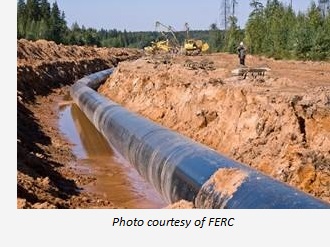
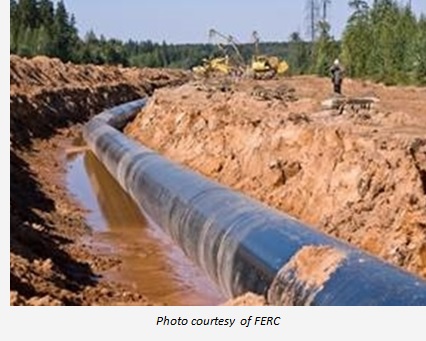 Energy projects, particularly pipelines, affect a range of aquatic resources, including wetlands. A single pipeline can cross hundreds of wetlands and streams. Disturbance of wetlands during pipeline development may also release greenhouse gasses. State §401 Certification review of energy development projects is a highly complex and time-consuming task, one that challenges most state wetland programs. The use of Section §401 to effectively participate in the FERC, DOE and other permit planning and review process relies on understanding about how energy permitting processes work. Early, upfront coordination between the state wetland program, federal permitting agencies, developers and their consultant intermediaries has been shown to be a key to successful aquatic resource protection.
To support this work, NAWM worked with a national workgroup to develop documents detailing pipeline permitting processes, points of access for wetland managers, key points of consideration for permit reviewers, best practices for mitigation of both permanent and temporary impacts, template energy project review materials to be adapted by state wetland programs and an online resource page with links to guidance, templates, tools, recorded webinars and contacts.
For more information and/or to join our email list for notices about upcoming events, please contact Laura Burchill at laura@nawm.org or (207) 892-3399.
View a List of Past Pipeline Permitting Webinar Recordings Here
As part of this project, NAWM delivered four webinars on topics that have been identified to address specific training needs:
NAWM Pipeline Permitting Webinars:
- July 18, 2018 – Improving the Information Pipeline: Working with Consultants During Oil and Gas Pipeline Permitting Processes – Clifford Brown, West Virginia Department of Natural Resources; Brenda Zollitsch, Association of State Wetland Managers; and Evan Hansen, Downstream Strategies, LLC
- July 24, 2018 – Cumulative Adverse Effects of Pipeline Development on Wetlands and Other Aquatic Resources – Wing Goodale, Biodiversity Research Institute
- October 29, 2018 – Horizontal Directional Drilling: Understanding Context when Reviewing Oil and Gas Pipeline Permit Applications– Richard Dalton, New Jersey Department of Environmental Protection; Patrick Ryan, New Jersey Department of Environmental Protection; Rick Gitar, Fond du Lac Reservation; Brenda Zollitsch, Association of State Wetland Managers
- November 7, 2018 – Pipeline Permitting 101 – Clifford Brown, West Virginia Department of Natural Resources; Robert Parker, Ollsson Associates; and Brenda Zollitsch, Association of State Wetland Managers
A List of Beaver Restoration Webinars Can Be Found Here. (PDF)
Members’ Wetland Webinar - Held March 20, 2019
Understanding State Agency Opportunities for Third Party Compliance Monitoring on Pipeline Projects
Presenters: Mike Warner, Transcon Environmental, Inc. and Jeff Davis, Transcon Environmental, Inc.
Members’ Wetland Webinar - June 12, 2019 - 3:00p.m.-4:30p.m. ET
Identifying Listed Species and Streamlining Section 7 Consultation for Wetland Permitting (And More): Introduction to the US Fish and Wildlife Service's Online IPaC Tool
Presenter: Victoria Foster, National IPaC Program Coordinator, U.S. Fish & Wildlife Service
The above NAWM Members’ Wetland Webinars are only available to NAWM Members. This is one of the many benefits available to NAWM members. For more information on the benefits of membership and how to join, click here. If you are a member of NAWM, please log in to the NAWM website to view the webinar held on March 20th and June 12th.
Webinar #4: Pipeline Permitting 101
Held Wednesday, November 7, 2018 – 3-5 pm ET
INTRODUCTION
- Brenda Zollitsch, Policy Analyst, Association of State Wetland Managers [PowerPoint Presentation]
PRESENTERS
- Clifford Brown, West Virginia Division of Natural Resources [Presentation #1: PowerPoint Presentation] [Presentation #2: PowerPoint Presentation]
- Robert Parker, Consultant [Presentation #1: PowerPoint Presentation] [Presentation #2: PowerPoint Presentation]
- Brenda Zollitsch, Association of State Wetland Managers [PowerPoint Presentation]
ABSTRACT
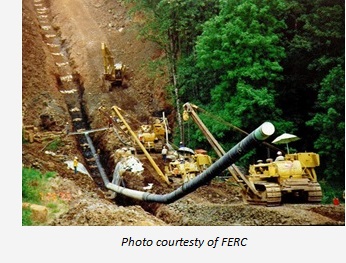
This webinar has been designed to help provide a basic overview for regulators that are new to oil and natural gas pipeline permitting and provide a review for others who already are engaged in this work. The webinar began with an overview of the expansion of oil and especially gas pipeline development in recent years and the associated growing need for review of pipeline permit applications by state and tribal aquatic resource regulators. The webinar covered pipeline basics – how pipeline projects are planned, the general steps in construction, and the potential to participate in a pre-application phase during which many key planning decisions are made. The webinar discussed the different processes involved in oil and gas permitting. Next, the webinar providef an overview of §401 Water Quality Certification and where this review process fits into overall planning and permitting. The webinar discussed examples of how states and tribes have dealt with conditioning §401 certifications and share lessons learned. The webinar concluded by describing new resources designed for those working on pipeline permitting that will soon be available on the Association of State Wetland Managers’ website.
BIOS
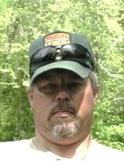 Clifford Brown has worked for West Virginia Division of Natural Resources, Wildlife Resources Section, since 1989 and currently serves in the DNR Environmental Coordination Unit as the lead for oil and gas related activities. Responsibilities include review of Section 401 applications, coordination with WVDEP and USEPA for mitigation and restoration associated with administrative orders and consent decrees, coordination with USFWS related to the National Wildlife Refuge System, Section 7 of the Endangered Species Act, Migratory Bird Treaty Act and the Wildlife and Sport Fish Restoration Program, coordination with the USFS for oil and gas projects on the Monongahela, George Washington and Jefferson National Forests in West Virginia, and serves on the AFWA Energy and Wildlife Policy Committee and the agency coordinator for review of FERC projects in West Virginia. He holds a B.S. in Biology and a M.S. in Wildlife and Fisheries Science from the Pennsylvania State University.
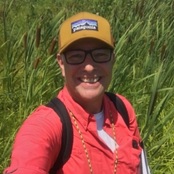 Robert Parker has worked in state government, nonprofits and consulting firms, developing a critical breadth of knowledge about the regulatory process from many perspectives. He is the former Section 401 Coordinator at Nebraska Department of Environmental Quality (NDEQ) and currently works as a independent consultant. While at NDEQ Robert also coordinated the state’s Storm Water Management Plan Grants Program and served as project manager for Watershed Management Plans in development by Nebraska Natural Resources Districts under the state's Nonpoint Source Management Plan. Before relocating to the Great Plains, Robert worked in the Great Basin region with threatened Lahontan cutthroat trout. He has a B.S. in Fisheries Biology from Humboldt State University, where he completed undergraduate research in genetic and morphologic differentiation in isolated populations of rough sculpin (Cottus asperrimus) in California’s Pit and Fall Rivers. Prior to his career in science and policy Robert spent nearly two decades working as a professional whitewater and fly fishing guide in Alaska, California, Montana, and Chile.
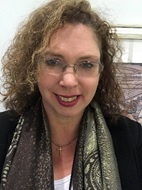 Brenda Zollitsch, PhD is Policy Analyst at the Association of State Wetland Managers, leading ASWM’s research on wetland and stream issues. She has been the PI on an ongoing multi-year project exploring ways to increase the effectiveness and efficiency of state and tribal permitting of oil and gas pipeline projects. In addition to her work for ASWM, Brenda serves as adjunct faculty at the University of Southern Maine’s Muskie School of Public Service teaching courses in public policy. She also assists water resource collaborations as a strategic planner and professional facilitator. Brenda holds her PhD in Public Policy from the University of Southern Maine’s Muskie School of Public Service and a double Masters’ degree in International Relations and Environmental Resource Management from Boston University.
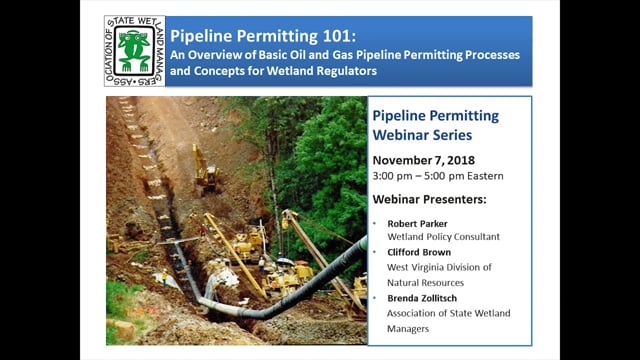
Part 1: Introduction: Brenda Zollitsch, Policy Analyst, Association of State Wetland Managers
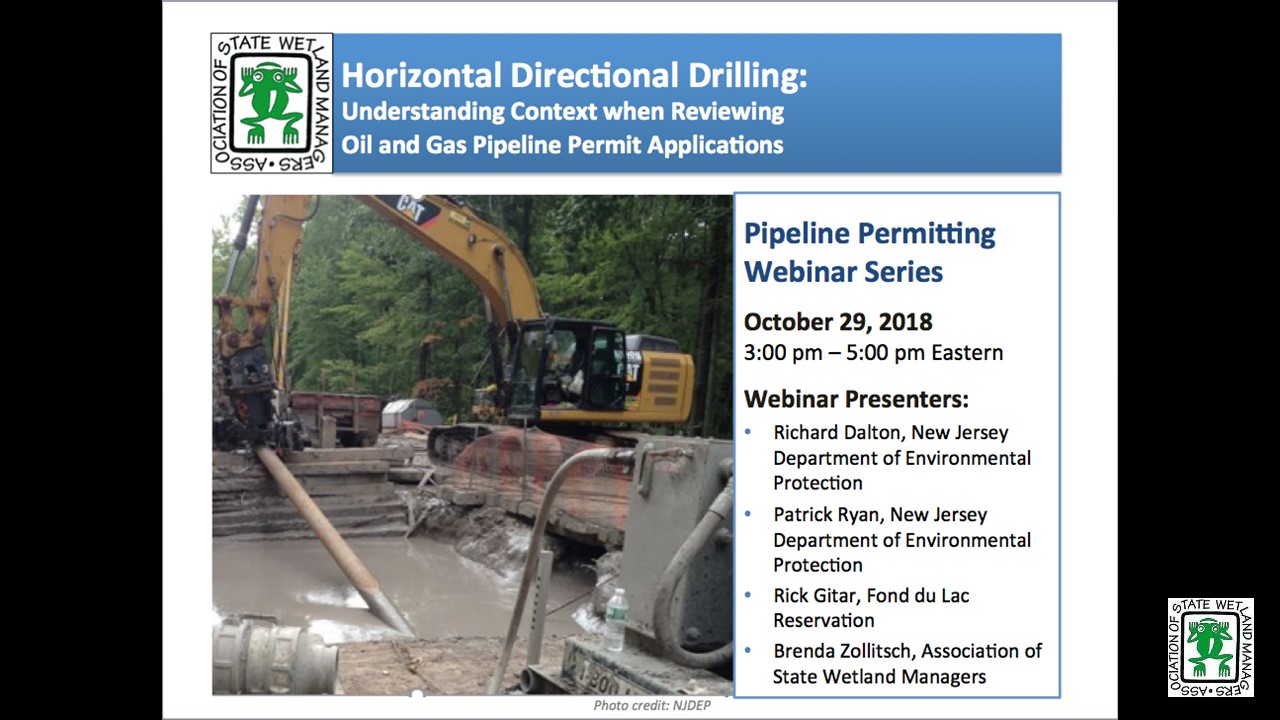
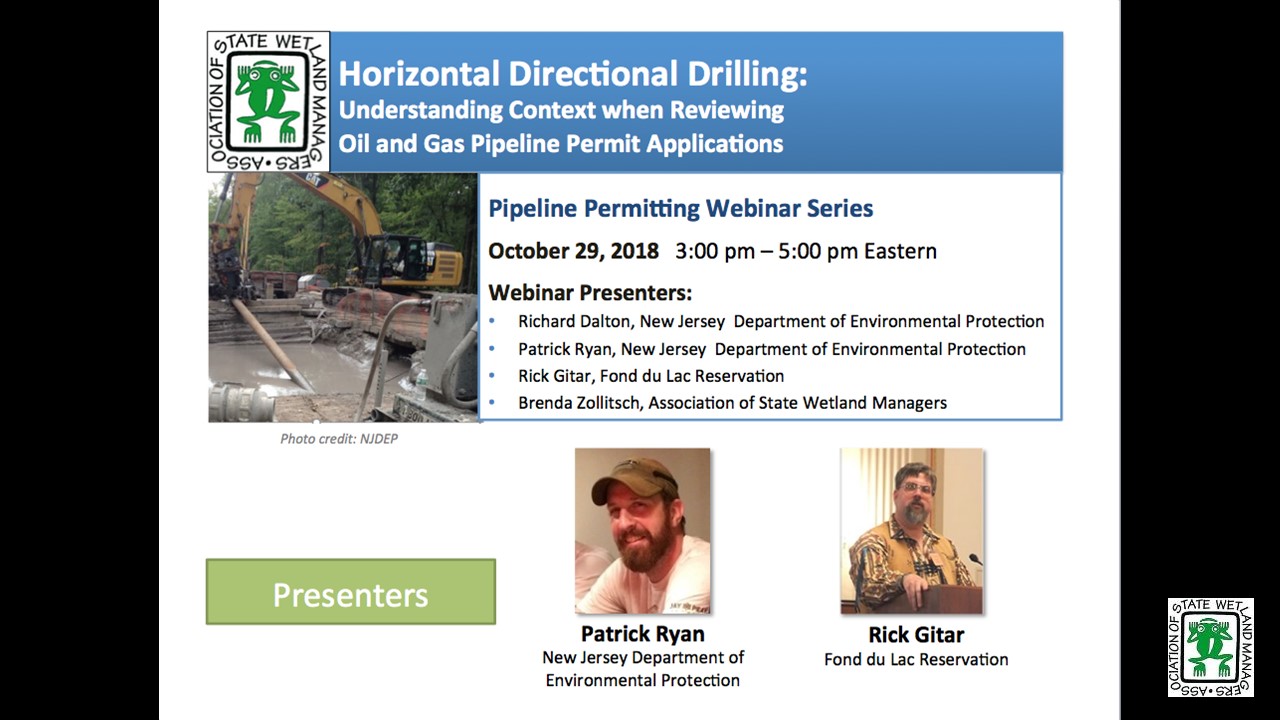
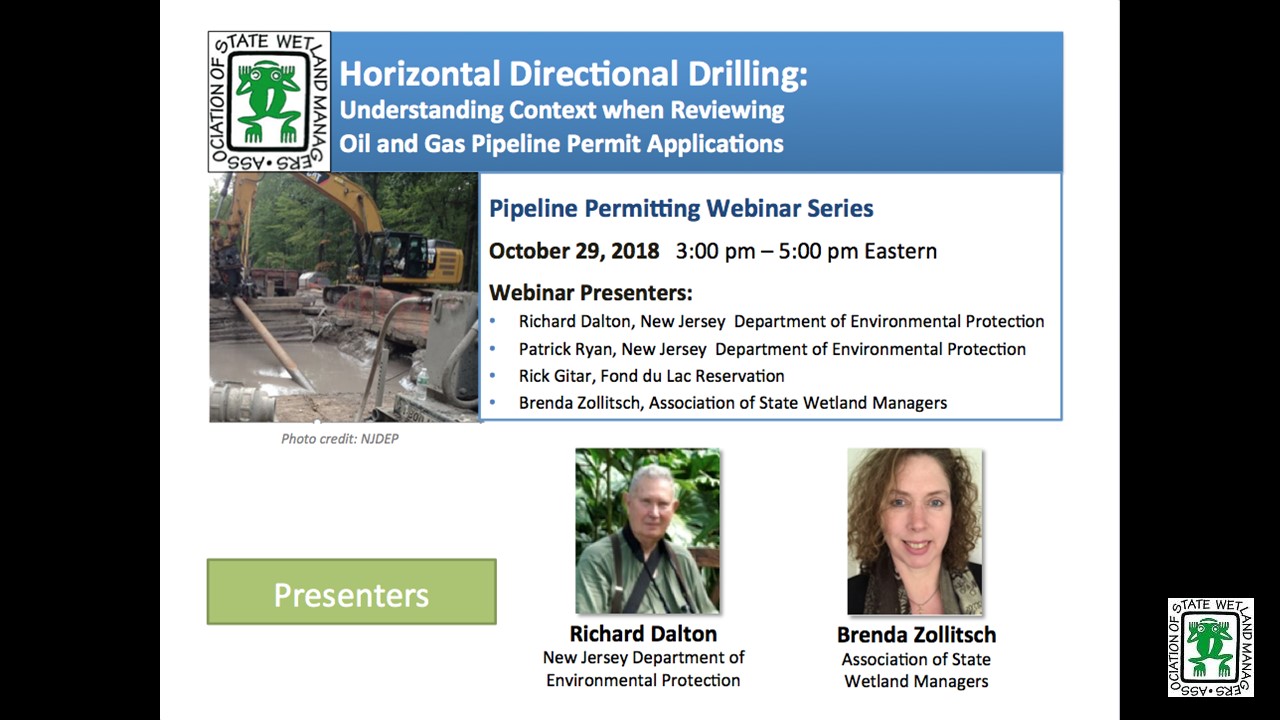
Webinar #3: Horizontal Directional Drilling: Understanding Context when Reviewing Oil and Gas Pipeline Permit Applications
Held Monday, October 29, 2018 – 3-5 pm ET
INTRODUCTION
- Brenda Zollitsch, Policy Analyst, Association of State Wetland Managers [PowerPoint Presentation]
PRESENTERS
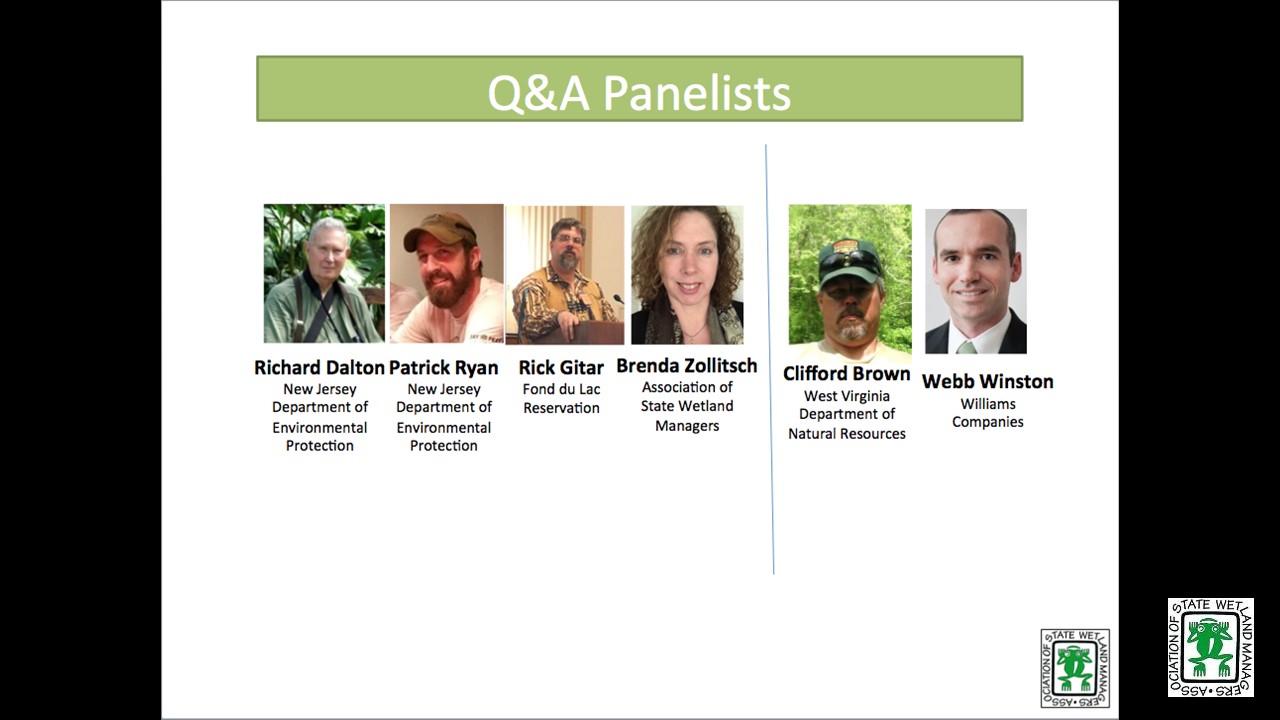
- Richard Dalton, New Jersey Department of Environmental Protection [PowerPoint Presentation]
- Patrick Ryan, New Jersey Department of Environmental Protection [PowerPoint Presentation]
- Rick Gitar, Fond du Lac Reservation [PowerPoint Presentation]
- Brenda Zollitsch, Association of State Wetland Managers [PowerPoint Presentation]
ABSTRACT
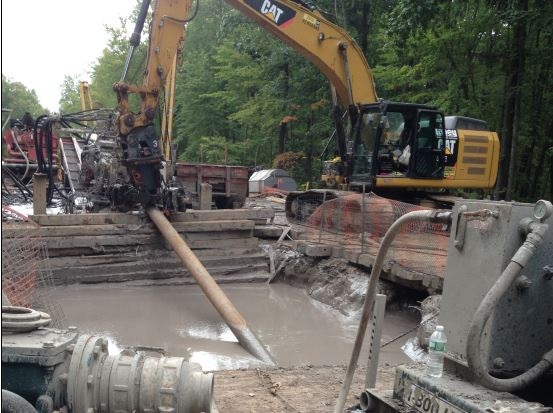
Horizontal Directional Drilling (HDD) is often considered a best practice for pipeline construction. However, in practice, HDD is only appropriate in certain contexts. This webinar started with a geology primer identifying contexts where HDD both commonly works and does not work well and why. Next, the state and tribal regulators shared their perspectives on reviewing permits that include HDD and some of their lessons learned. They shared the kinds of information that it is beneficial for reviewers to request and common considerations when reviewing and conditioning permit applications that include proposed HDD. Alternatives to HDD and their strengths and weaknesses also was discussed. The webinar concluded with information about new resources for those working on pipeline permitting efforts that will soon be available on the Association of State Wetland Managers’ website.
BIOS
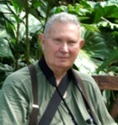 Richard Dalton is a Geologist and Manager for the Office of the State Geologist in the Division of Water Supply and Geoscience at the New Jersey Department of Environmental Protection. He started with the Bureau of Geology and Topography in spring of 1967 where he was involved mapping the limestone and dolomite geology of northwestern New Jersey. He spent six years doing spill response of oil and hazardous chemicals, then was moved back to the New Jersey Geological Survey where he works in the Office of the State Geologist today. He is also a member of the New Jersey Well Drilled and Pump Installers Licensing Board. He holds a BA in geology from Rutgers University.
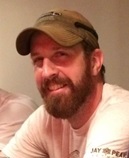 Patrick Ryan is an Environmental Supervisor within the Division of Land Use Regulation at the New Jersey Department of Environmental Protection. He supervises a permitting staff responsible for environmental reviews of wetlands, highlands, waterfront, and flood hazard area permit applications for northern New Jersey. Mr. Ryan has a M.S. in Ecology from Penn State University and a B.S. in Natural Resource Management from Cook College, Rutgers University.
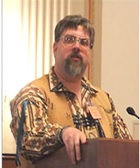 Rick Gitar is the Water Regulatory Specialist and Tribal Inspector for the Fond du Lac Reservation – Office of Water Protection, located in northeast Minnesota, where he has worked for over 20 years. He is the administer of Fond du Lac’s Wetlands Protection and Management Ordinance, their Clean Water Act 401 Water Quality Certification program, and provides CWA Section 402 oversight for projects on the Reservation. Rick is also a credentialed inspector for EPA, conducting compliance inspections in the areas of wetlands and storm water. He conducts Fond du Lac’s environmental reviews under NEPA and the tribe’s Tribal Environmental Policy Act Ordinance. Rick received a double major B.S. in Biology (Botany Focus) and Journalism from the University of Wisconsin – Superior and a M.S. in Environmental Biology (Botany Focus) from the University of Minnesota – Duluth. Rick is also a Master Herbalist and teaches adult extension classes. He is currently enrolled in the online Doctorate of Herbal Medicine Program with AMNAH College.
Brenda Zollitsch, PhD is Policy Analyst at the Association of State Wetland Managers, leading ASWM’s research on wetland and stream issues. She has been the PI on an ongoing multi-year project exploring ways to increase the effectiveness and efficiency of state and tribal permitting of oil and gas pipeline projects. In addition to her work for ASWM, Brenda serves as adjunct faculty at the University of Southern Maine’s Muskie School of Public Service teaching courses in public policy. She also assists water resource collaborations as a strategic planner and professional facilitator. Brenda holds her PhD in Public Policy from the University of Southern Maine’s Muskie School of Public Service and a double Masters’ degree in International Relations and Environmental Resource Management from Boston University.
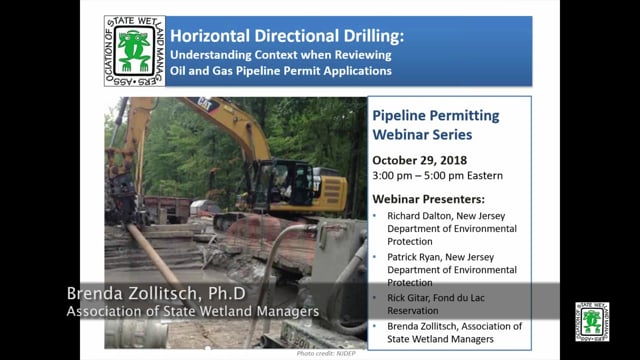
Part 1: Introduction: Brenda Zollitsch, Policy Analyst, Association of State Wetland Managers Presenter: Richard Dalton, New Jersey Department of Environmental Protection
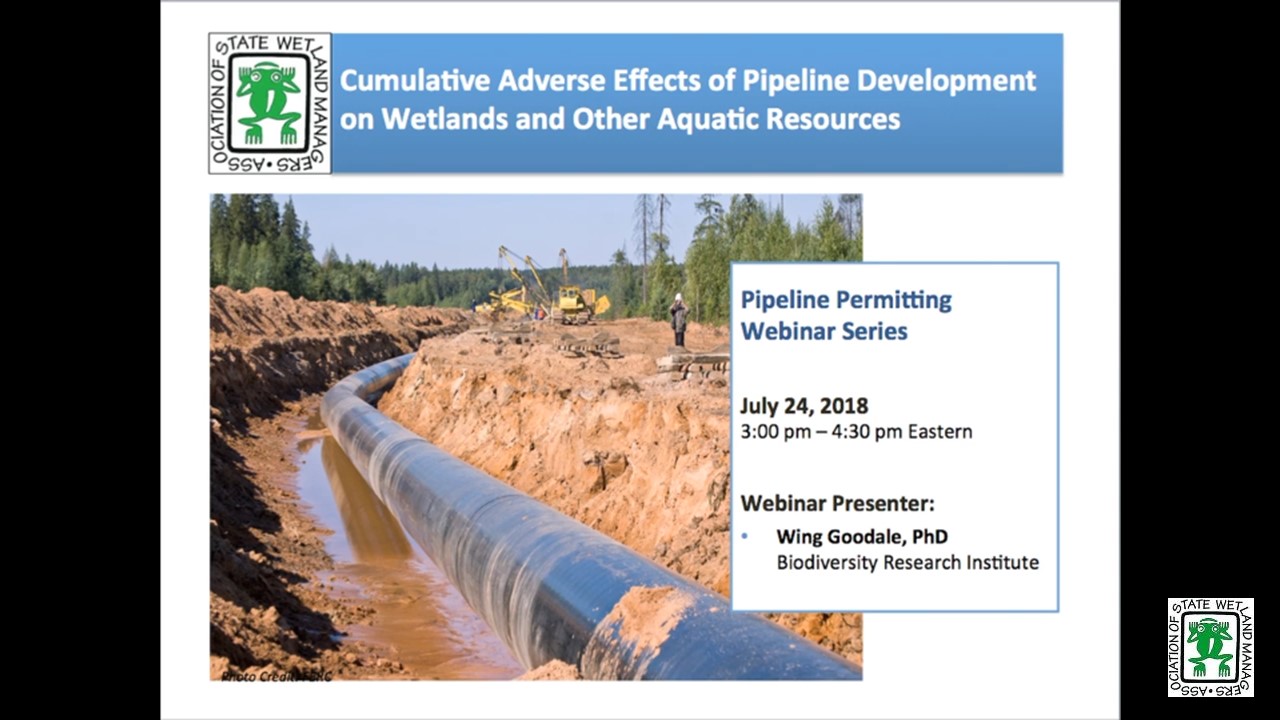
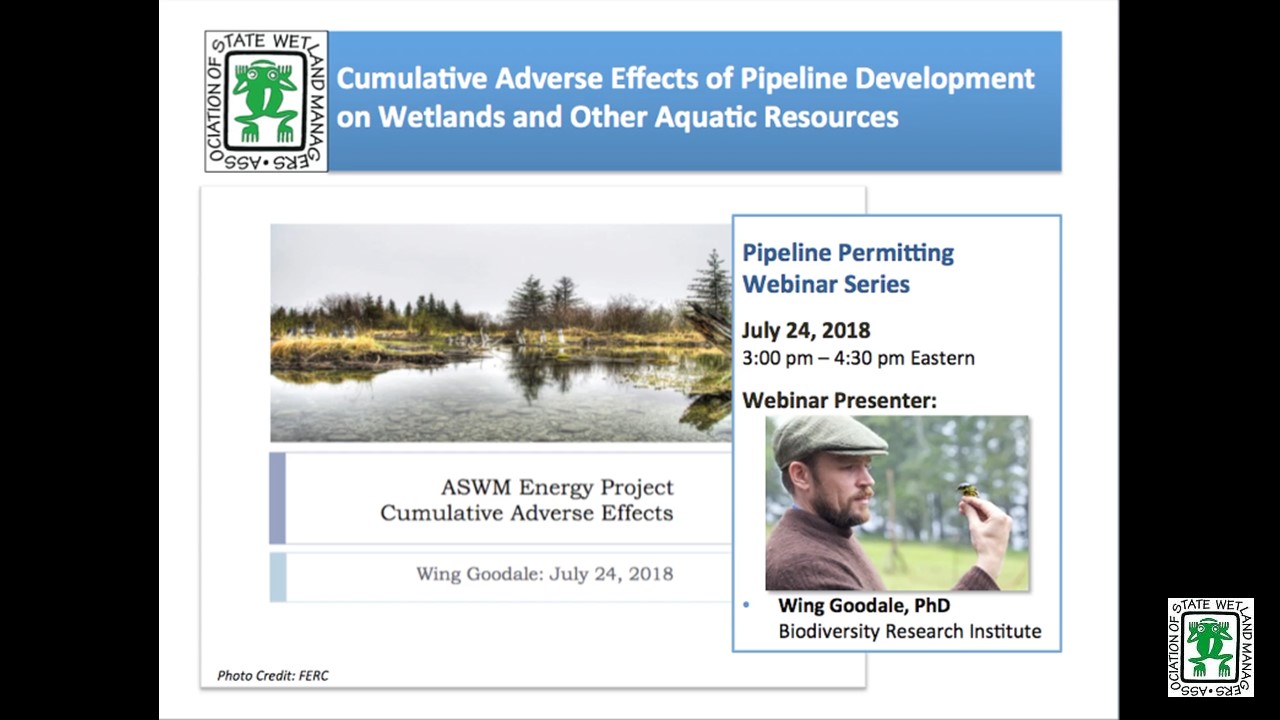
Webinar #2: Cumulative Adverse Effects of Pipeline Development on Wetlands and Other Aquatic Resources
Held Tuesday, July 24, 2018 at 3 pm ET
INTRODUCTION
- Brenda Zollitsch, Policy Analyst, Association of State Wetland Managers [PowerPoint Presentation]
- Webinar Series Information [PowerPoint Presentation]
PRESENTER
- Wing Goodale, Biodiversity Research Institute [PowerPoint Presentation]
ABSTRACT
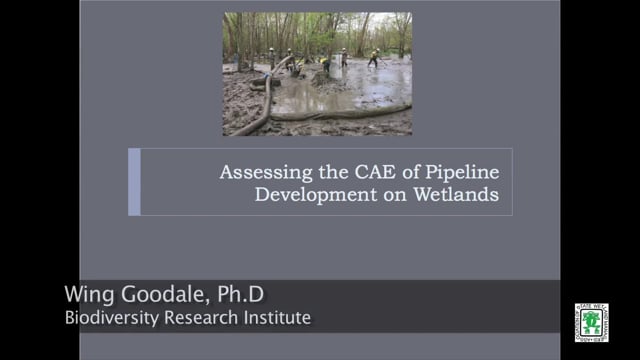
Energy projects, particularly pipelines, affect a range of aquatic resources, including wetlands. Impacts to wetlands from pipeline activities range from both short- and long-term destruction and disruption of wetlands and other aquatic resources to water quality impacts, habitat loss, increasing invasive species and compromised quality of critical areas. The adverse effects of a pipeline on a single wetland are important, but of equal or greater concern is the effect of pipelines that cross multiple watersheds and multiple wetlands. A single pipeline can cross hundreds of wetlands and streams, which can lead to cumulative adverse effects (CAE).
This webinar provided an introduction about how CAE can be conceptualized, the language used to discuss CAE, and the legal basis for CAE. The presentation discussed a framework for considering adverse effects, including a review of general approaches for CAE assessments and ways to address these effects. The webinar concluded with the presentation of a thought-provoking approach to conducting simple assessment of CAE that could be adapted for use by wetland professionals as they work to identify and address CAE for projects they are planning and/or permits they are reviewing. The webinar ended with information about the Association of State Wetland Managers’ recent pipeline permitting project and forthcoming resources on CAE that will be available on ASWM’s website.
 BIO
BIO
Wing Goodale is Senior Deputy Director for the Center for Ecology & Conservation Research and Director for the Biodiversity Research Institute (BRI) in Maine. He is a NSF IGERT fellow in the UMass Offshore Wind Energy Program. Goodale has worked at BRI since 2000 and is now the deputy director. At BRI, he has raised or helped manage over $7.5 million of funds for more than 60 conservation biology projects. Goodale has served on municipal committees, environmental nonprofit boards, professional boards, and college boards, including the governor appointed Maine Board of Environmental Protection. Wing is a Ph.D. Candidate in the Department of Environmental Conservation at University of Massachusetts, Amherst. He also has his Master of Philosophy in Human Ecology from the College of the Atlantic and his Bachelor of Arts in Biology from Colorado College.
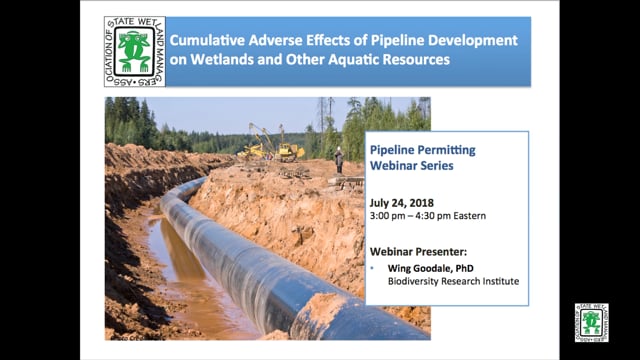
Part 1: Introduction: Brenda Zollitsch, Policy Analyst, ASWM
Presenter: Wing Goodale, Biodiversity Research Institute
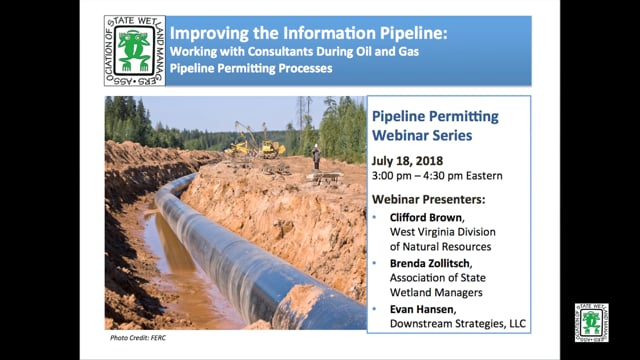
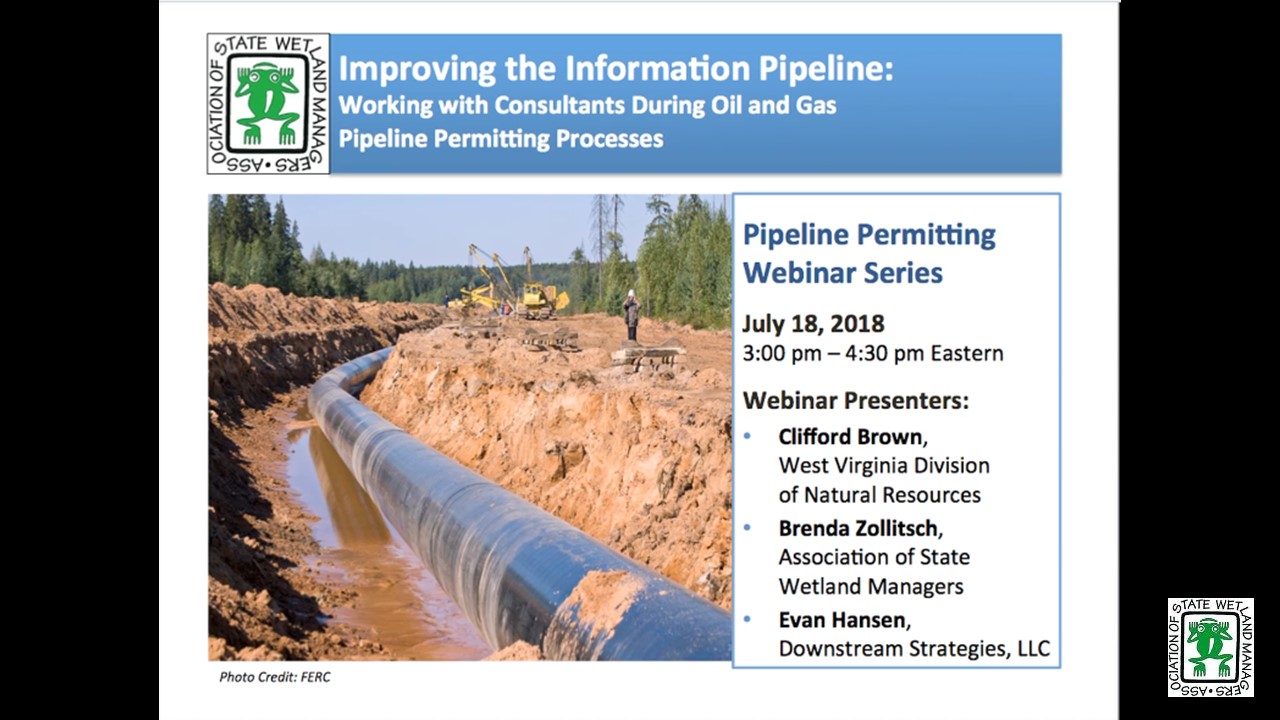
 Webinar #1: Improving the Information Pipeline: Working with Consultants During Oil and Gas Pipeline Permitting Processes
Held Wednesday, July 18, 2018 at 3 pm ET
INTRODUCTION
- Brenda Zollitsch, Policy Analyst, Association of State Wetland Managers [PowerPoint Presentation]
PRESENTERS
- Clifford Brown, West Virginia Department of Natural Resources [PowerPoint Presentation]
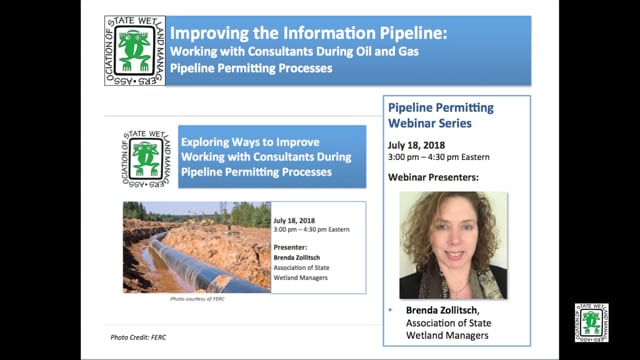
- Brenda Zollitsch, Association of State Wetland Managers [PowerPoint Presentation]
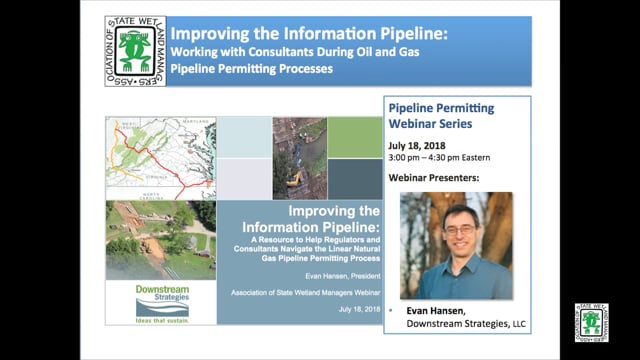
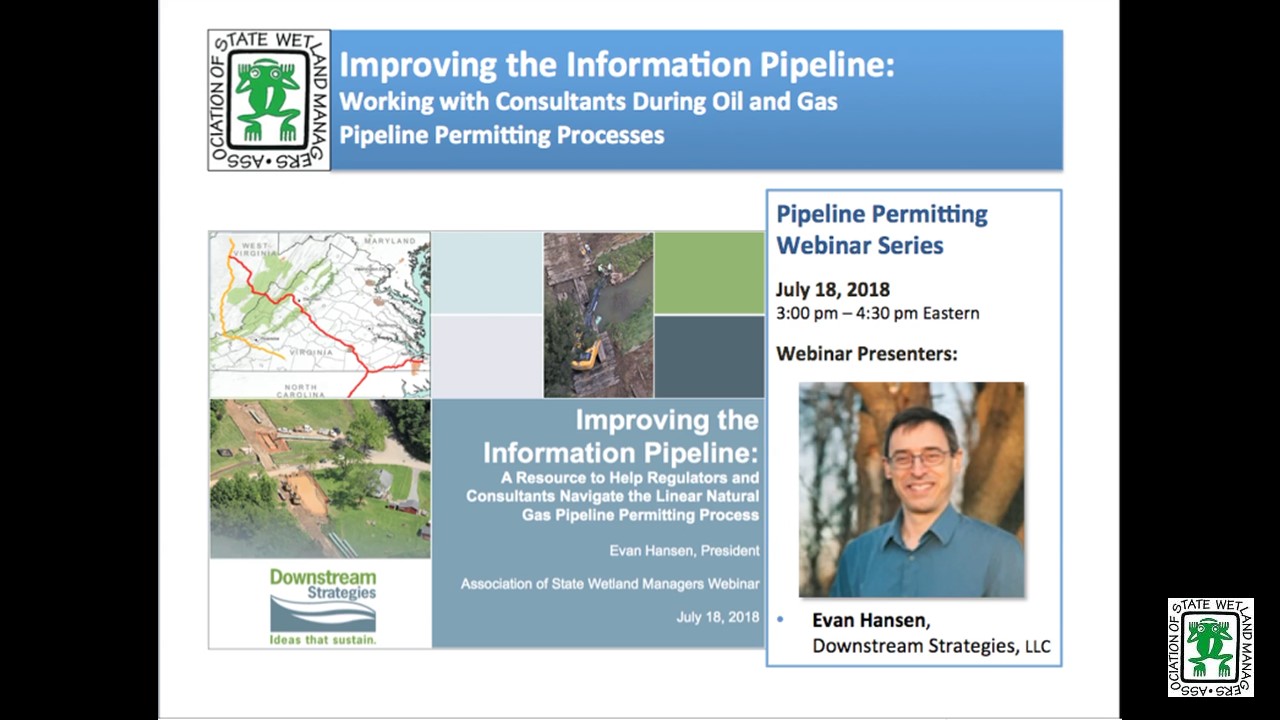
- Evan Hansen, Downstream Strategies, LLC [PowerPoint Presentation]
ABSTRACT
This webinar provided insights about how wetland and other aquatic resource regulators can improve working relationships with consultants who serve as intermediaries for energy companies working on oil and gas pipeline development projects. This webinar shared insights from state permit reviewers on some of the common challenges, ranging from different understandings of permitting processes, points of access, pipeline terms and use of language. The webinar discussed helpful ways of working together to establish common understanding, share key concerns about impacts to aquatic resources and incorporate best practices to address those impacts. The webinar presented a new resource developed by ASWM to help guide more productive conversations and relationships between regulators and consultants, focusing on creating transparency, common understandings, and strong relationships that facilitate both efficient permit review processes and protection of aquatic resources.
BIOS
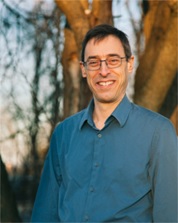 Evan Hansen is Principal of Water and Energy Programs for Downstream Strategies, LLC a consulting firm in West Virginia. Evan’s work focuses on resource and environmental problems and solutions in three areas: water, energy, and land. He manages interdisciplinary research teams, performs quantitative and qualitative policy and scientific analyses, provides litigation support and expert testimony, develops computer tools, provides training, and performs field monitoring. He is engaged in ongoing source water protection activities and works with watershed organizations and agencies on Clean Water Act and Surface Mining Control and Reclamation Act issues such as permits, TMDLs, antidegradation, and watershed-based plans. Evan has his M.S. in Energy and Resources from the University of California, Berkeley and his B.S. in Computer Science and Engineering from the Massachusetts Institute of Technology. Evan is a Switzer Environmental Fellow and has worked with ASWM on this project through a Network Innovation Grant from the Robert and Patricia Switzer Foundation.
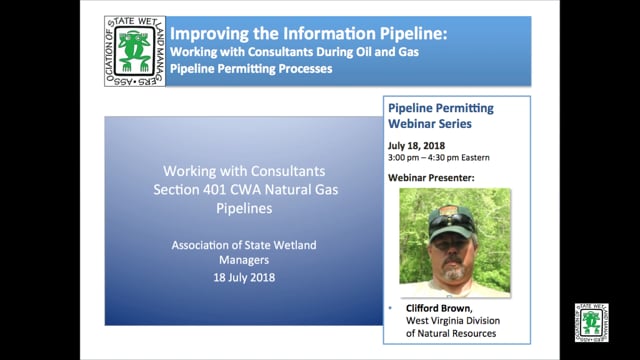
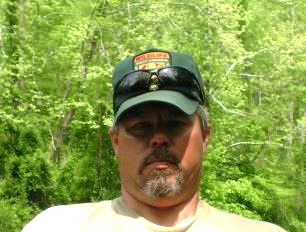 Clifford Brown has worked for West Virginia Division of Natural Resources, Wildlife Resources Section, since 1989 and currently serves in the DNR Environmental Coordination Unit as the lead for oil and gas related activities. Responsibilities include review of Section 401 applications, coordination with WVDEP and USEPA for mitigation and restoration associated with administrative orders and consent decrees, coordination with USFWS related to the National Wildlife Refuge System, Section 7 of the Endangered Species Act, Migratory Bird Treaty Act and the Wildlife and Sport Fish Restoration Program, coordination with the USFS for oil and gas projects on the Monongahela, George Washington and Jefferson National Forests in West Virginia, and serves on the AFWA Energy and Wildlife Policy Committee and the agency coordinator for review of FERC projects in West Virginia. He holds a B.S. in Biology and a M.S. in Wildlife and Fisheries Science from the Pennsylvania State University.
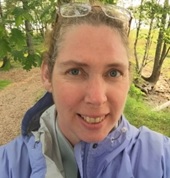 Brenda Zollitsch, PhD is a Policy Analyst at the Association of State Wetland Managers. Brenda conducts research and policy analysis on wetland and stream issues. Brenda has recently completed a national status and trends/state summaries project analyzing 50 state wetland programs across the United States and a national stream identification, delineation and mitigation study, a communications case study project and a wetland training needs assessment and enhancement project. She currently leads projects focused on increasing access to high quality wetland training and improving energy permitting to protect wetlands. In addition to her work for ASWM, Brenda is a Switzer Environmental Fellow, serves as adjunct faculty at the University of Southern Maine teaching courses in public policy and sustainable communities and assists water resource collaborations as a professional facilitator. Brenda holds her PhD in Public Policy from the University of Southern Maine’s Muskie School of Public Service and a double Master’s degree in International Relations and Environmental Resource Management from Boston University.
Part 1: Introduction: Brenda Zollitsch, Policy Analyst, Association of State Wetland Managers
Presenter: Clifford Brown, West Virginia Department of Natural Resources
View a List of Past Pipeline Permitting Webinar Recordings Here
 The National Association of Wetland Managers (NAWM) holds eight webinars per year for members. NAWM Member webinars cover a variety of topics encompassing wetland science, policy, program implementation, and legal issues. These webinars, including recordings for past webinars are available to NAWM members.
Not a NAWM Member? Join or Renew
For more information about this webinar series, please contact Laura Burchill at laura@nawm.org or
(207) 892-3399. Learn more about sponsorship opportunities.
If you haven’t used Teams before or you just need a refresher, please view our guide prior to the webinar.
View Past NAWM Members Webinar Series Here
View a List of Past NAWM Members Webinar Series Recordings Here
Please check back for future Members webinars. Thank you.
To view Past Members Wetland Webinars:
Members You must be logged in.
Nonmembers To view recent Members Webinars, please join NAWM.
View Past Members Webinar Series Here
View a List of Past Members Webinar Series Recordings Here
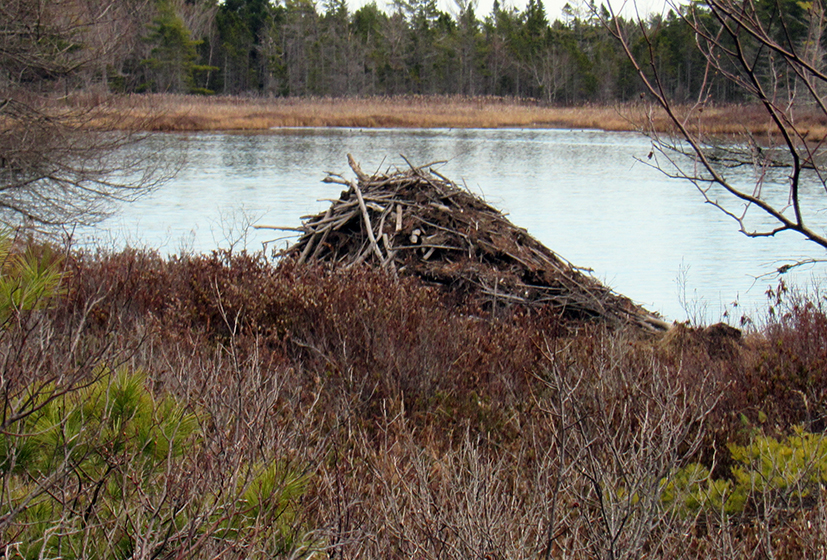 The National Association of Wetland Managers (NAWM) formerly the Association of State Wetland Managers (ASWM), and the Bureau of Land Management (BLM) collaborated to develop a series of webinars introducing the topic of restoration of aquatic ecosystems through the reintroduction of beavers, the use of beaver dam analogues (BDAs) or restoration designed to attract beavers to an area to contribute to changing hydrology and restoring ecosystem services. The webinar series was planned by a national workgroup of beaver restoration experts and webinars are presented by expert practitioners, managers and researchers working in the field. In 2020-2021, the six-part webinar series covered the basics of beaver restoration and continuing through implementation challenges and ways to encourage beaver restoration projects. The series has been added to our Online Trainings library, available here.
If you haven’t used Teams before or you just need a refresher, please view our guide prior to the webinar here.
View Past Beaver-related Restoration Webinars

Please check back for future Beaver-related Restoration Webinars.