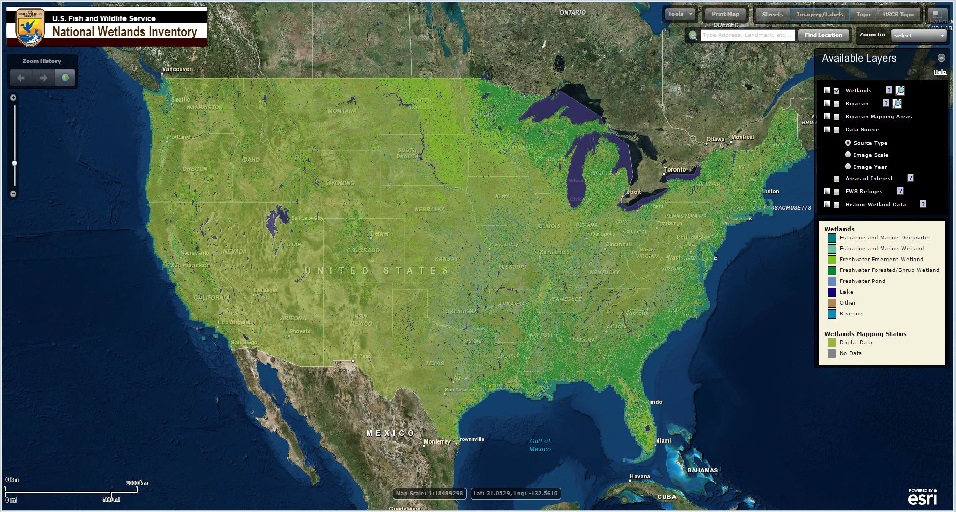
The Wetland Mapping Consortium (WMC), founded in 2008, is an interdisciplinary group of wetland scientists and managers interested in mapping and monitoring wetlands with remotely sensed images and/or using the resultant products to best manage wetland resources. The WMC Steering Committee organizes webinars on topics of interest to the group.

If you haven’t used Teams before or you just need a refresher, please view our guide prior to the webinar here

For more information and/or to join our email list for notices about upcoming events, please contact Laura Burchill at laura@nawm.org or (207) 892-3399.  

Past Wetland Mapping Consortium Webinars Here

List of Wetland Mapping Consortium Webinar Recordings Here

  

In Preparation for Next-Generation Wetland Mapping and Monitoring with NISAR

Wednesday, June 10, 2026 - 3:00 p.m. - 4:00 p.m.Register Here

PRESENTER

Laura Bourgeau-Chavez, Michigan Technological University

ABSTRACT

The recently launched NASA-ISRO (Indian Space Research Organization) NISAR mission provides unprecedented opportunities for systematic wetland monitoring through 6-12 day repeat coverage (with ascending and descending modes). NISAR collects dual-frequency L-band synthetic aperture radar (SAR) observations globally and quadrature polarization over select areas, including the midwestern US (much of the Great Lakes). This presentation will highlight the added capability of NISAR for global wetland mapping and monitoring. Imagery from the new satellite will be shown, but the big release of data will not be until July 2026. Therefore, recent wetland research using the airborne version of NISAR, L- and S-band ASAR, acquired over Great Lakes coastal wetlands will be presented. In this research we assessed multi-frequency polarimetric data from ASAR’s L- and S-bands as well as C-band from Radarsat-2. Using these quadrature polarized data, we demonstrated the capabilities and limitations of each wavelength for mapping wetland inundation beneath varying vegetation structures and biomass conditions. Comparisons among frequencies show differing sensitivities to flooded vegetation, canopy structure, and scattering mechanisms, improving our understanding of how wavelength and polarization influence inundation detection in complex wetland environments. For this often cloud covered region, we also assessed wetland type mapping using the single date of fully polarimetric L- and S-band ASAR data, and high classification accuracies were achieved across diverse wetland classes. In addition, we evalutated SAR retrieval algorithms for wetland vegetation biomass. The longer wavelength of L-band provides greater vegetation penetration capability to detect inundation and estimate biomass, thus it is highly complementary to both C-band (e.g. Sentinel-1) and optical-IR data (e.g. Sentinel-2 and Landsat) for monitoring wetlands. 

BIO

Laura Bourgeau-Chavez, Michigan Technological UniversityLaura Bourgeau-Chavez, PhD is Chief Research Scientist and Sensing the Natural Environment Practice Area Lead at Michigan Tech Research Institute. She is Adjunct Associate Professor in Michigan Technological University’s College of Forest Resources and Environmental Sciences. Laura has extensive experience in ecological research and remote sensing with a focus on wetlands and Synthetic Aperture Radar (SAR). She uses SAR alone or with other sensors to detect cryptic vernal pools, map wetland ecosystem types and to monitor inundation and soil moisture patterns. Her team has mapped wetlands across regions from the tropics to the boreal-arctic, including mountain peatland systems. Her research has had a strong focus on the Great Lakes coastal wetlands as well as boreal peatlands. Laura is particularly passionate about peatlands, which she has been researching for over twenty years and in 2021 she served as a coordinating lead author for the United Nations' Global Peatland Assessment. Bourgeau-Chavez holds a Bachelors of Science and Masters of Science from the University of Michigan in Natural Resources and Forest Ecology, respectively, and a PhD in Forest Ecology and Remote Sensing from the University of New Brunswick, Fredericton, N.B. Her dissertation was on using synthetic aperture radar satellite data to monitor fuel moisture in boreal ecosystems for fire danger assessment. As an adjunct associate professor at Michigan Tech, Bourgeau-Chavez serves on PhD and MS committees and gives occasional lectures on remote sensing of wetlands.

Register Here
